

“An Objective Evaluation of Textual Variants, Script Evolution, and State Censorship.”
Ordinary Muslims across the Indian subcontinent and globally believe that the Qur’an is perfectly preserved, flawless down to a single word, vowel marker (Zair-Zabar), or diacritical dot, unchanged from its inception to the present day. This claim remains an indispensable pillar of contemporary Islamic teachings and theology.
However, a detached academic analysis of primary Islamic sources (Hadith, Tafsir), ancient manuscripts, and historical research reveals that the preservation, compilation, and standardization of the Qur’an was an extensively complex, gradual, and highly political process. This comprehensive article provides an objective assessment of the text’s authenticity, real-world status, and historical development based on foundational Islamic evidence and historical data.
1. The Islamic Claim: Absolute Preservation and the Dilemma of “Al-Zikr”
Islamic scholars frequently argue that Allah has personally guaranteed the absolute protection of the Qur’an. This assertion relies almost entirely on a foundational verse:

Surah Al-Hijr (15:9) > “Indeed, it is We who sent down the message (Al-Zikr), and indeed, We will be its guardian.”
While traditional discourse treats this verse as definitive proof that the current Qur’an has remained entirely unaltered, a granular linguistic and critical textual analysis uncovers two profound theological dilemmas:
The Classical Islamic View:
The most authoritative and classical commentators (Mufassirin) in Islamic tradition, such as Imam Al-Tabari, Ibn Kathir, and Imam Al-Qurtubi, unanimously assert in their respective exegeses that the word “Al-Zikr” (الذِّكْر) used in this verse refers strictly and exclusively to the Qur’an. They maintain that despite the use of a broad terms, the direct contextual focus is the text revealed to Prophet Muhammad, the structural integrity of which Allah undertook to safeguard personally.
Critical Academic Evaluation:
While this classical interpretation satisfies traditional faith commitments, it faces severe scrutiny under the rigorous standards of textual criticism and linguistics, presenting two major difficulties:
- The First Dilemma (Linguistic Ambiguity): The original Arabic text of the verse does not contain the word “Qur’an”; it employs the noun “Al-Zikr” (meaning “the reminder” or “divine message”). From a textual perspective, it remains an unresolved question why a highly generalized and all-encompassing noun was used if the divine promise was meant strictly for the word-for-word preservation of a singular, specific book.
- The Second Dilemma (Historical Inconsistency): The Qur’an itself explicitly uses the terms “Zikr” and “Ahl al-Zikr” to refer to prior divine revelations, such as the Torah, Psalms, and Gospel (e.g., Surah Al-Anbiya 21:7, 21:105). If these prior revelations fall under the linguistic umbrella of divine Zikr, their protection historical failed according to core Islamic doctrine itself, which maintains that earlier scriptures were physically and textually corrupted (Tahrif) by human hands.
A Critical Logical Question: If this verse outlines a universal divine law regarding the absolute protection of God’s revealed messages (Al-Zikr), how did preceding scriptures undergo systemic textual corruption despite the presence of an omnipotent Guardian? Conversely, if this protection was completely exclusive to the Qur’an, the absence of explicit specific terminology, coupled with widespread primary Hadith reports detailing lost or missing portions of the text, casts a deep historical and logical doubt over the standard narrative of unalterable preservation.
2. The Logico-Theological Paradox of “Muhaymin” (The Guardian)
To understand the fate of previous scriptures and the explicit role assigned to the Qur’an in relation to them, a specific verse from Surah Al-Ma’idah serves as a central theological pillar:
Surah Al-Ma’idah (5:48) “…And We have revealed to you the Book in truth, confirming that which preceded it of the scripture and as a ‘Muhaymin’ (Muhayminan ‘Alayh – مُهَيْمِنًا عَلَيْهِ) over it…”
Here, the literal and primary definition of the Arabic word “Muhaymin” is a guardian, watchman, or supreme protector.
Analyzing this verse with its primary linguistic definition introduces a glaring logical paradox. If Allah appointed the Qur’an to act as the primary ‘guardian’ or ‘protector’ over previous scriptures, yet those very books became textually corrupt, it directly implies a functional failure of that designated guardian. Because the guardian (the Qur’an) is the literal speech of Allah, concluding that it failed in its divinely ordained protective responsibility directly contradicts the core tenets of Islamic theology.
The Classical Islamic View:
To circumvent this logical breakdown, classical theologians and Arabists argue for alternative, broader definitions of Muhaymin. They claim it does not imply a physical or protective guardian meant to shield earlier manuscripts from human alteration. Instead, they interpret its role through the following concepts:
- The Criterion (Criterion / Shahidah): A tool to filter out and identify human changes within older books.
- The Witness (Witness): A text that testifies to the original core message delivered by earlier prophets.
- The Supervisor (Supervisor): A final authority that preserves the eternal, essential truths of past scriptures within its own verses. Consequently, traditional theology maintains that the corruption of past books does not represent a failure of the Qur’an, as its purpose was to serve as a qualitative criterion rather than a physical shield.
Critical Academic Evaluation:
Even if one completely accepts these alternative definitions (Criterion or Witness), the academic and structural problem is simply shifted to a new dilemma:
- The Practical Vacuum of a Criterion: If a source text (the Torah or Gospel) has been entirely corrupted and textually compromised, as traditional narrative claims, how can any subsequent ‘criterion’ look at that corrupted text and distinguish precisely which specific sentence was originally divine and which was fabricated?
- The Contradiction of Confirmation: The verse explicitly notes that the new book arrives “confirming” (Musaddiqan – مُصَدِّقًا) the scripture that came before it. Textual critics raise a vital question: How can a text realistically ‘confirm’ or ‘testify to’ a document that is already deemed systemically altered or lost? If a witness validates a changed document, either the validation itself becomes suspect, or the document was not nearly as corrupted as contemporary apologetics claim.
A Critical Logical Question: > Whether Muhaymin is interpreted through its primary definition of a ‘guardian’ or re-framed as a ‘criterion,’ both scenarios present major historical problems for the traditional narrative. If earlier scriptures were completely corrupted, the Qur’an’s status as a guardian or confirming criterion transforms into a practical vacuum – vouching for a text that no longer exists in its true form. This strongly indicates that either the early Islamic understanding of Tahrif (corruption) was fundamentally different from the rigid textual corruption claimed by modern scholars, or the divinely instituted framework faces a profound historical contradiction in achieving its stated purpose.
3. Textual Corruption Verses and the Linguistic Nuance of “Al-Kitab”
Islamic apologists regularly cite specific Quranic verses to prove that prior scriptures (like the Torah and Gospel) were textually corrupted and rewritten by human actors:
Surah Al-Baqarah (2:79) “So woe to those who write the ‘book’ with their hands and then say, ‘This is from Allah,’ to exchange it for a small price…” (Similar thematic contexts appear in Surah Ali ‘Imran 3:78 and Surah Al-Ma’idah 5:13)
When text-critical and linguistic analyses are applied to the original Arabic wording and contextual deployment of these verses, a stark divide emerges between traditional assumptions and academic reality.
The Classical Islamic View:
Mainstream scholars and commentators argue that the context of revelation (Shan-e-Nuzool) for these verses is unambiguous. They were directed at Jewish and Christian religious elites living in and around Medina who manipulated divine laws for financial or political gain. Consequently, mainstream Islamic thought views this as conclusive proof that the physical text of the Torah, Psalms, and Gospel was textually altered and ruined.
Critical Academic Evaluation:
Accepting the historical context does not resolve the deep linguistic challenges uncovered by modern text-critical scholars:
- The Complete Absence of Specific Names: None of these disputed verses explicitly mention the “Torah” (Torah), “Psalms” (Psalms), or “Gospel” (Gospel) when making accusations of alteration. Instead, they exclusively employ the generalized definite noun “Al-Kitab” (الْكِतَاب – meaning “The Book” or “The Scripture”) while alleging changes, leaving later theologians to retroactively infer that the verse meant the physical texts of previous revelations.
- Interpretative Manipulation vs. Physical Corruption: Academic historians emphasize that phrases like “writing the book with their hands” or “distorting the book with their tongues” (Surah Ali ‘Imran 3:78) strongly point toward interpretative manipulation or oral deception rather than the total physical destruction or textual replacement of the source manuscripts. In other words, the underlying texts remained intact, but their public exposition was being corrupted.
- A Double-Edged Linguistic Sword: This introduces an acute linguistic crisis. The historical acts of “writing a scripture down with human hands” and “reciting it with shifting vocal modulations” are the exact physical and historical mechanisms through which the Qur’an itself was compiled, written down, and preserved across varying tribal recitations (Ahruf/Qira’at).
- The Problem of Equal Application: The Qur’an uses the exact title “Al-Kitab” to refer to itself dozens of times (e.g., Surah Al-Baqarah 2:2). If generalized accusations against “Al-Kitab” are accepted as historically absolute without requiring specific proper nouns, then by the laws of linguistics, these same structural vulnerabilities can be applied to any scriptural compilation written down by human hands – including the Qur’an – since it also constitutes “Al-Kitab” within the divine text.
A Critical Logical Question: This textual reality strongly indicates that the Qur’an contains no explicit, direct accusation of systemic, word-for-word physical corruption against previous revelations using their proper names. The absolute claim that previous scriptures were entirely altered down to the letter is an inference popularized by later scholars rather than a direct textual statement from the verses. If the physical text of those scriptures had truly been corrupted out of existence, it remains unexplained why the divine text avoided naming those specific books directly in its legal indictments.
4. The Compilation of the Qur’an: A Historical and Analytical Perspective
The State of the Text During the Prophet’s Lifetime
During the lifetime of Prophet Muhammad (ﷺ), the Qur’an did not exist in a single, bound volume or book. The text was entirely scattered. Verses were recorded fragmentarily on palm leaves, flat stones, camel shoulder blades, pieces of leather, and wooden boards, while various companions committed portions to memory (Hifz).
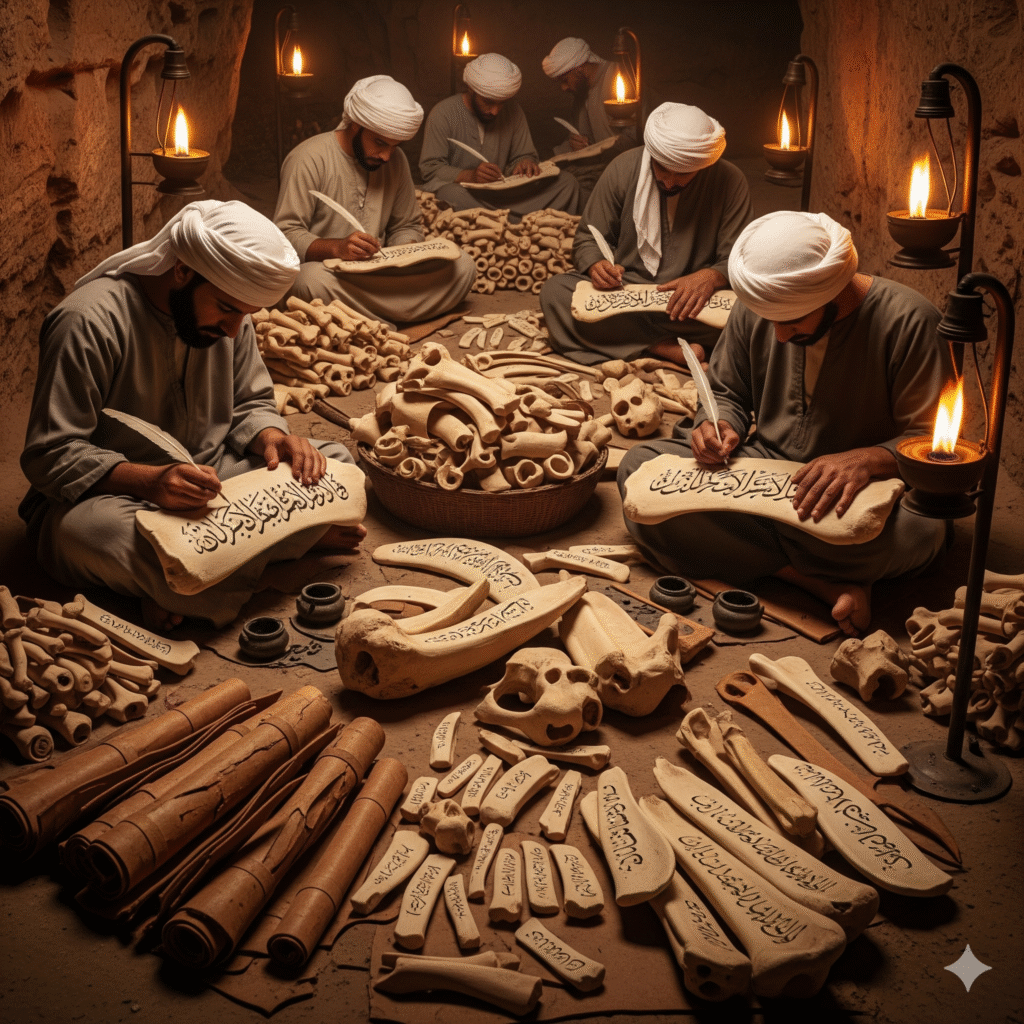
The Prophet passed away without ever leaving a written, systematic, or practical directive to gather these scattered pieces into a single, unified official book.
Sahih Al-Bukhari 4986: > “The Prophet died and the Qur’an had not been compiled into a book.” (See also Sahih Al-Bukhari 4968)
Sahih Bukhari 4968 (Scan from sunna.com)
When a vast number of elite Quranic reciters (Qurra/Huffaz) among the companions were martyred in the Battle of Yamama (where the Muslims fought the self-proclaimed prophet Musaylimah), a deep apprehension arose that major portions of the text would be lost forever. Consequently, Umar ibn al-Khattab suggested to Abu Bakr that the fragments be compiled into a single book.
🔹 Crucial Implication: This historical sequence demonstrates that during the lifetime of Prophet Muhammad (ﷺ), no officially standardized or single-volume Qur’an existed.
Abu Bakr’s Era: The First Compilation (632–634 CE) and the Fear of Loss
Immediately following the Prophet’s death, the ‘Battle of Yamama’ took place during the caliphate of Abu Bakr. In this fierce conflict, a high number of companions who preserved the Qur’an through oral memorization (Qari/Hafiz) were slain.
This critical loss sparked an intense anxiety in the mind of Umar ibn al-Khattab. He feared that if the Hafiz companions continued to fall in battles, a significant portion of the Qur’an would be lost to oblivion forever. He aggressively pressured Abu Bakr to codify the text into a unified book. Abu Bakr initially hesitated, noting that this was a task the Prophet himself had not undertaken, but he ultimately relented and commanded Zayd ibn Thabit to gather the scattered fragments.
Bukhari 4986 (Scan from sunna.com)
The Structural Academic Question:
If the Qur’an was under an absolute guarantee of supernatural protection and entirely safe within oral memory, why did the closest companions experience such a profound, immediate panic regarding its permanent disappearance? Why did they feel an urgent, human necessity to bind it into a physical book to prevent its loss? This historical anxiety strongly indicates that the complete destruction of significant textual portions was recognized as a real, distinct hazard at the time.
Linguistic Deficiencies of the Primitive Script (Rasmul Khat)
When the Qur’an was first committed to writing, the contemporary Arabic script (deeply influenced by the Nabataean script) was highly primitive and incomplete. This early orthography is known as the “Skeleton Script” (Skeleton Rasm). This rudimentary script possessed only 16 or 18 foundational letterforms to represent the 28 distinct consonantal sounds of the Arabic language. Crucially, this script completely lacked diacritical dots (Nuqte) and short vowel markers (I’rab – such as Zair, Zabar, Pesh).
For example, without diacritical dots, a single ambiguous, undulating written stroke could be read as a Ba (ب), a Ta (ت), a Tha (ث), a Noon (ن), or a Ya (ي). Similarly, there was no visual distinction between a Qaf (ق) and a Fa (ف).
The Historical Outcome: Due to these inherent script deficiencies, when individuals from different Arab tribes encountered the unpointed skeleton text, they naturally read and decoded it based on their own understanding, tribal dialects, and regional accents. This ambiguity rapidly gave rise to major differences in words, grammar, and meanings (Variant Readings) during the earliest decades of Islam.
The Uthmanic Standardization and the Burning of Variant Recensions (650 CE)
As the Islamic empire rapidly expanded into distant regions like Syria and Iraq, severe disputes erupted among Muslims from different provinces regarding the correct wording and meaning of the Quranic text. The arguments grew so fierce that believers began accusing one another of heresy and apostasy.
Sahih Al-Bukhari 4987: > Hudhayfah bin al-Yaman, upon returning from the military campaigns in Armenia and Azerbaijan, urgently warned Caliph Uthman: “O Chief of the Believers! Save this ummah before they differ about their Book (Qur’an) the way the Jews and the Christians differed before them.”
Recognizing the gravity of this political and religious crisis, Caliph Uthman requested the manuscript compiled under Abu Bakr (which was kept in the private custody of Hafsah). He appointed a four-member committee led by Zayd ibn Thabit with an explicit mandate: “In case you disagree with Zayd ibn Thabit on any point in the Qur’an, write it in the dialect of the Quraish, for the Qur’an was revealed in their tongue.”
Bukhari 4987 (Scan from sunna.com)
Once this committee finalized a singular official copy adjusted to the Quraishi dialect, Uthman distributed duplicate copies to the major metropolitan centers of the empire and issued a sweeping, absolute political decree:
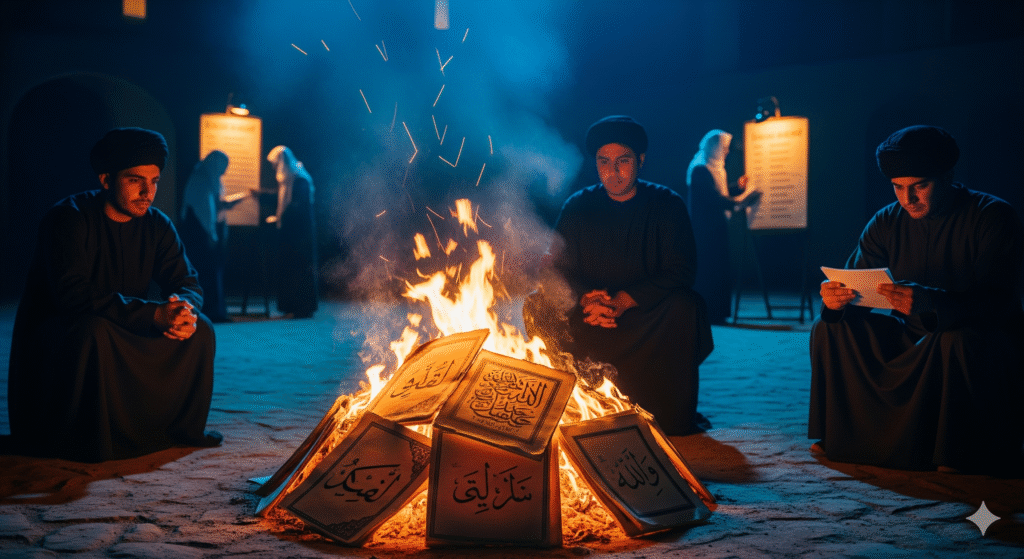
Sahih Al-Bukhari 4987 (Concluding Section): > “…and Uthman ordered that all the other written materials of the Qur’an, whether fragmentary manuscripts or complete copies (Codices) held by other companions, be burned to ashes.”
This historical event confirms that prior to Uthman’s standardization, multiple competing versions (Variant Codices) containing different words, distinct surahs, and variant verse orders were actively used by senior companions. These alternative texts were permanently erased through centralized state power.
A Serious Historical Question: > If the Qur’an had been perfectly uniform and word-for-word identical across the entire community from the very beginning, why did the state find it necessary to gather and burn the written collections of the Prophet’s closest companions by military force? This historical purge demonstrates that a diversity of text-forms existed prior to Uthman, directly contradicting the popular claim of a single, unvaried text stretching back to the revelation.
5. Textual Loss: Missing Verses and Disputed Surahs Within Primary Sources
The claim of total textual preservation is directly challenged by explicit accounts within primary Islamic literature detailing legal codes and scriptural content that were once recited as scripture but are missing from the modern text.
A. The Stoning Verse (Rajam) and Contemporary Sharia Paradoxes
The most authentic collections (Sahih Al-Bukhari and Sahih Muslim) record that Caliph Umar ibn al-Khattab, during his final sermon from the pulpit (Minbar), explicitly declared that a verse mandating Rajam (stoning to death for married adulterers) was originally part of the revealed Quranic text. He noted that the companions had read, understood, and memorized it, yet it was ultimately omitted from the compiled manuscript (Sahih Al-Bukhari 6830, Sahih Muslim 1691).
Muslim 1691 (Scan from sunna.com)
The Traditional Islamic View: Islamic jurisprudence classifies this phenomenon under the theological doctrine of ‘Mansukh al-Tilawah’ (Abrogated in Recitation but Retained in Law). Traditional scholars argue that Allah intentionally erased the text of these verses from the public recitation of the Qur’an while preserving their legal force within Sharia law.
Critical Academic Assessment and Practical Paradoxes: If the removal of this text was purely a controlled divine act, Umar’s recorded historical anxiety makes little sense. He explicitly stated: “I am afraid that with the lapse of time, people will say, ‘We do not find the verse of Rajam in the Book of Allah,’ and thus go astray… Had it not been for the fear that people would say ‘Umar has added to the Book of Allah,’ I would have written it into the text myself.” Umar’s explicit fear demonstrates that the inclusion or exclusion of text was governed by human administrative hesitation rather than a seamless divine script.
The Real-World Impact: A profound contemporary contradiction emerges here: If the Rajam verse is textually absent from the modern Qur’an, why do groups like ISIS, the Taliban, and various modern Sharia-governed states continue to execute women by public stoning? The absolute refusal of mainstream Islamic institutions to condemn the legal validity of stoning reveals that they practically treat this missing verse as an unyielding divine mandate. This reality dismantles the public narrative that the current printed Qur’an contains every single essential, binding law of the faith down to the letter.
B. The “Goat Eating the Text” Account and the Adult Breastfeeding (Rada’at al-Kabeer) Edict
The most concrete historical description of physical text destruction appears in a famous report from the Prophet’s wife, Aisha (Rज़ि.). She states that the verses governing stoning and the mandate of ten explicit breastfeedings for adults were written down on a sheet (Sahifah) kept under her bedding. During the chaotic aftermath of the Prophet’s death, a domestic animal (a goat or sheep) entered the room and ate the manuscript sheet.
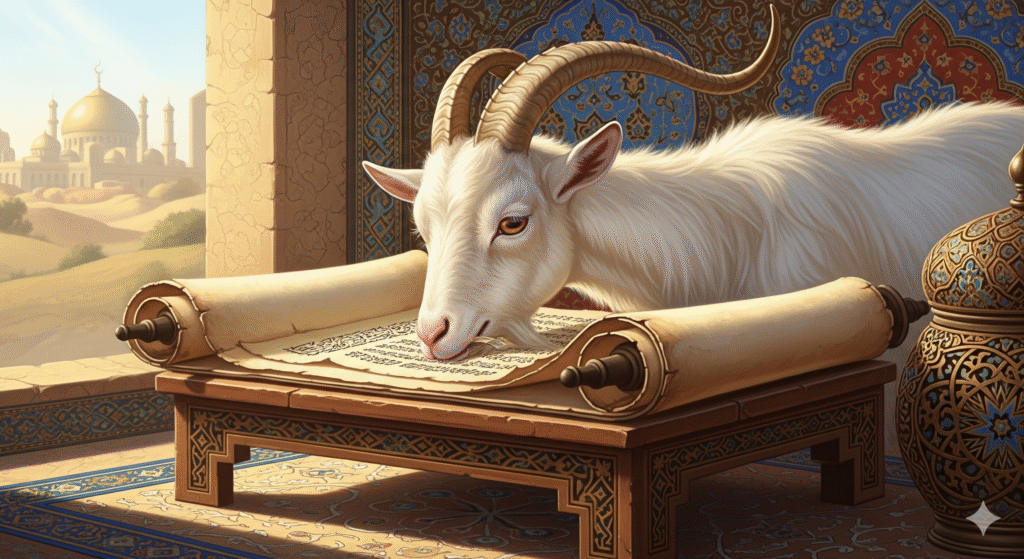
The Traditional Islamic View: Modern apologists frequently attack the structural authenticity (Isnad) of this report in Sunan Ibn Majah (1944), labeling it weak (Da’eef) by pointing to a specific narrator, Muhammad bin Ishaq. Alternatively, those who accept it fold it into the doctrine of Mansukh al-Tilawah, arguing that the animal’s intervention was simply the physical mechanism chosen by Allah to fulfill his plan to abrogate the text.
Sunan Ibn Majah (Scan from sunna.com)
The Definitive Witness of Sahih Muslim and Modern Fatwa Crises: Attempting to dismiss the account as ‘weak’ becomes structurally irrelevant when encountering the legal reality of “Adult Breastfeeding to Establish Mahram Status” within Sahih Muslim (1452A). The authentic text records that the Prophet explicitly ordered the wife of Abu Hudhayfah to breastfeed an adult male slave named ‘Salim’ so that he could enter her household without violating modesty laws.
Sahih Muslim 1452A (Scan from sunna.com)
Sunan Ibn Majah 1944 (Scan from sunna.com)
The Connection to Modern Times (The Al-Azhar Controversy): This is not an obscure medieval debate. In May 2007, Dr. Izzat Atiya, head of the Hadith Department at Egypt’s prestigious Al-Azhar University, issued an official fatwa based strictly on this authentic Hadith. He asserted that modern female office workers could symbolically provide milk to their male co-workers to establish a legal ‘mahrameeyah’ (familial relationship), thereby permitting them to work together behind closed doors in accordance with Sharia law. Following intense global ridicule and intense political pressure, Al-Azhar rapidly cancelled the fatwa and suspended Dr. Atiya. However, the event proved that the legal concept remains an active, structurally integrated component of Islamic theology.
A Critical Logical Question: Since the legal framework of adult breastfeeding is textually authenticated by Sahih Muslim, and its real-world implementation has been attempted by modern institutions like Al-Azhar, dismissing the accompanying Ibn Majah account of the lost sheet as a ‘weak report’ is an unviable defensive maneuver. This reality strongly indicates that the physical loss of early Quranic sheets was a historical fact, which later orthodoxy sought to obscure behind complex theological frameworks of abrogation and chain-of-narrator technicalities.
C. Fragmented Codices: The Disputed Surahs of Ibn Mas’ud vs. Ubayy ibn Ka’b
The highest authorities on Quranic recitation certified by the Prophet himself held fundamentally conflicting views regarding the total number of chapters (Surahs) that constituted the true text.
Abdullah ibn Mas’ud (रज़ि.): The companion whom the Prophet personally ordered Muslims to learn the Qur’an from first (Sahih Al-Bukhari 3758). His private codex contained only 111 Surahs. He actively excluded Surah Al-Fatiha (the opening chapter) and the final two chapters (Al-Falaq and An-Nas), maintaining that the final two were merely protective prayers recited by the Prophet for his grandsons, not the literal speech of God.
Sahih Bukhari 3758 (Scan from sunna.com)
Ubayy ibn Ka’b (रज़ि.): Hailed by the Prophet as the supreme master of the reciters (Sayyid al-Qurra). His codex contained 116 Surahs, featuring two entire additional chapters missing from the modern text: Surah Al-Khl’ (سورة الخلع) and Surah Al-Hafd (سورة الحفد), which modern Muslims recite only as supplementary prayers (Dua-e-Qunut).
The Traditional Islamic View: Apologists claim these variant codices were merely “private notebooks.” They argue Ibn Mas’ud omitted Surah Al-Fatiha because it was so widely memorized that writing it down was redundant, while Ubayy ibn Ka’b merely scribbled additional personal prayers alongside the divine text. They assert that once the community achieved consensus (Ijma) under Uthman’s 114-surah draft, all companions abandoned their private texts.
Critical Academic Assessment: This traditional defense creates a massive logical breakdown. If the most elite masters of the scripture, explicitly endorsed by the Prophet, could not agree on whether the literal word of God contained 111, 114, or 116 entire chapters, the claim that the text was seamlessly, uniformly, and universally preserved without textual variation across the early community is historically untenable.
5. Ahruf vs. Qira’at and Contemporary Textual Variants
A. The Translation Game: The Distinction Between Ahruf and Qira’at
A highly misleading interpretation regarding the compilation and textual methodology of the Qur’an is frequently found in the translation of theological traditions (Hadith):
📖 Sahih Al-Bukhari (2419):
Umar ibn al-Khattab narrated: I heard Hisham bin Hakim reciting Surah Al-Furqan in a way different from how I recited it, and the Prophet had taught it to me. I grabbed him by his neck and brought him to the Prophet. The Prophet listened to both recitations and stated, “It was revealed in this way. Indeed, this Qur’an was revealed in seven distinct Ahruf (سبعة أحرف — Seven Ahruf/Dialects/Words), so recite it in whichever way is easiest for you.”
Bukhari 2419 (Scan from sunna.com)
The Translation Discrepancy and Semantic Shift
In the Urdu and Hindi translations prevalent across the Indian subcontinent and other regions, the word “Ahruf” is frequently and defensively substituted with “Qira’at” or described as mere ‘tribal accents/pronunciations’ (Dialect/Accent).
The Traditional Islamic View:Traditional scholars maintain that the seven Ahruf were simply a divine concession allowing various Arab tribes of the era to recite the Qur’an in their natural native accents. According to them, this flexibility did not alter the underlying words or core meanings but was strictly a phonetic variation.Reference to Imam Al-Suyuti: The celebrated 15th-century scholar Imam Al-Suyuti, in his renowned encyclopedic work ‘Al-Itqan fi ‘Ulum al-Qur’an’, explicitly acknowledged that the exact definition of “Ahruf” is a subject of over 35 contradictory opinions among the Ulema and remains an unresolved mystery to this day.
Critical Academic Evaluation:Linguists and textual criticism scholars firmly challenge this oversimplified harmonization, noting a profound structural difference in Arabic grammar:
- Qira’at (Reading Styles): Refers strictly to minor variations in vocalization, pronunciation, or intonation that do not change the underlying consonantal words.
- Ahruf (Textual/Lexical Forms): Refers to structural variations in actual words (Words), consonants (Letters), and grammatical templates (Grammar). When root letters and words change, their legal (Legal) and theological meanings alter fundamentally.
A Critical Logical Question:
Textual critics raise a vital inquiry: If the divergence was merely a matter of regional accents (Accents), why did Caliph Umar violently seize Hisham bin Hakim by his collar upon hearing his recitation of Surah Al-Furqan (Sahih Al-Bukhari 2419)? Caliph Umar and Hisham bin Hakim both belonged to the exact same Quraish tribe and shared the identical native dialect. Umar’s intense hostility demonstrates that the divergence was lexical and textual (Ahruf) rather than phonetic (Qira’at), directly undermining the narrative of absolute word-for-word textual uniformity.
The 10 Canonical Qira’at (Textual Transmissions) and Their Rawis (Narrators)
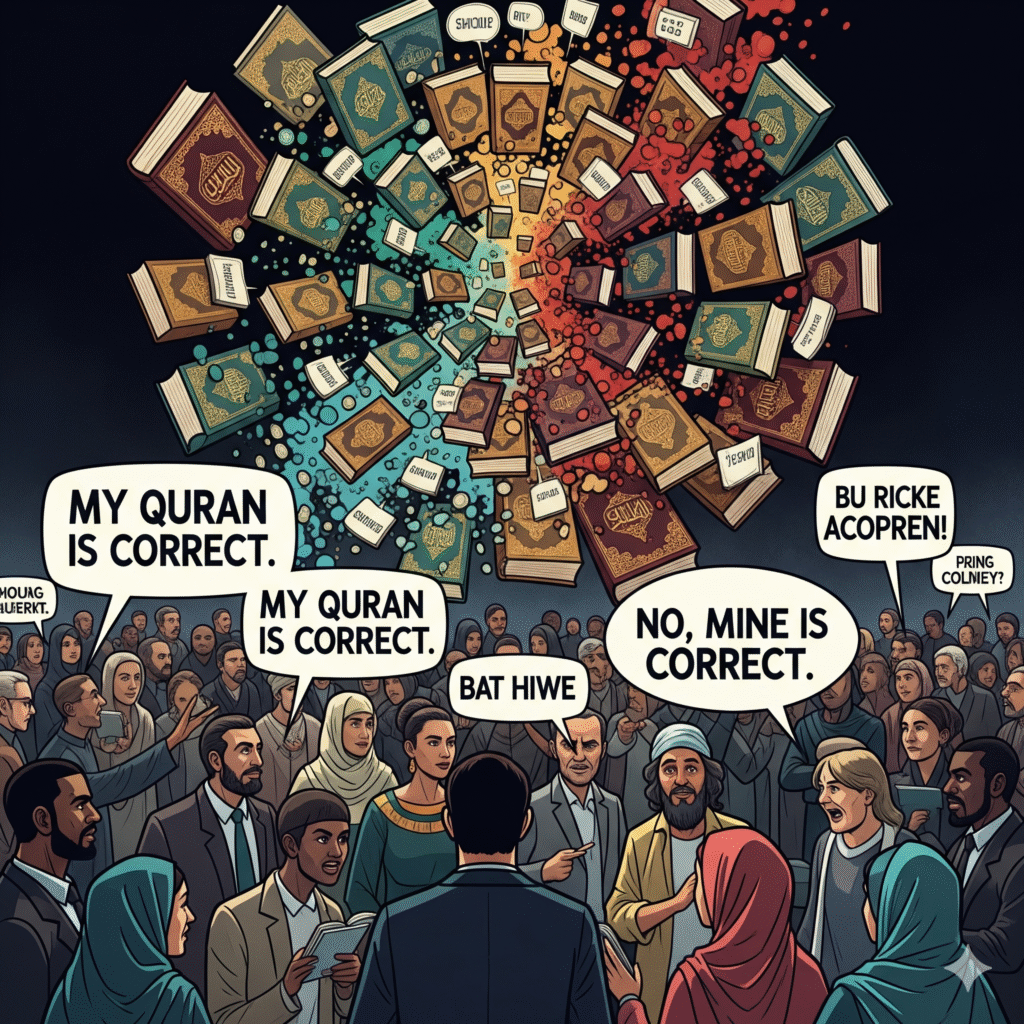
In historical Islamic linguistics, 10 primary textual variants are canonized, consisting of 7 Mutawatir (highly authentic) transmissions and 3 Mashhur (famous) transmissions. For scholarly accuracy, each master Reciter is presented below along with their two main authorized narrators (Rawis):
The 7 Mutawatir Qira’at
- Nafi’ al-Madani (d. 169 AH / 785 CE)
- Rawi 1: Qalun
- Rawi 2: Warsh — (Officially utilized across Morocco and West Africa)
- Ibn Kathir al-Makki (d. 120 AH / 737 CE)
- Rawi 1: Al-Bazzi
- Rawi 2: Qumbul
- Abu ‘Amr ibn al-‘Ala (d. 154 AH / 770 CE)
- Rawi 1: Al-Duri
- Rawi 2: Al-Susi
- Ibn ‘Amir al-Shami (d. 118 AH / 736 CE)
- Rawi 1: Hisham
- Rawi 2: Ibn Dhakwan
- Asim ibn Abi al-Najud (d. 127 AH / 744 CE)
- Rawi 1: Shu’bah
- Rawi 2: Hafs — (Standardized edition utilized across 95% of the Muslim world, including South Asia and Saudi Arabia)
- Hamzah al-Kufi (d. 156 AH / 772 CE)
- Rawi 1: Khalaf
- Rawi 2: Khallad
- Al-Kisa’i (d. 189 AH / 804 CE)
- Rawi 1: Al-Layth (Abu al-Harith)
- Rawi 2: Al-Duri
The 3 Mashhur Qira’at
- Abu Ja’far al-Madani (d. 130 AH / 747 CE)
- Rawi 1: Isa ibn Wardan
- Rawi 2: Sulayman ibn Jammaz
- Ya’qub al-Basri (d. 205 AH / 820 CE)
- Rawi 1: Ruways
- Rawi 2: Rawh
- Khalaf al-Bazzar (d. 229 AH / 843 CE)
- Rawi 1: Ishaq
- Rawi 2: Idrees
Academic and Historical References:
- “Kitab al-Sab’ah fi al-Qira’at” by Ibn Mujahid (10th Century) – The classical work that first formalized and systematized the canon of the seven recitations.
- “Al-Nashr fi al-Qira’at al-Ashr” by Ibn al-Jazari – The definitive historical compilation mapping out the precise technical rules for all 10 recitations and their respective Rawis.
B. Real-World Textual Diversity: The Hafs vs. Warsh Divergence
Modern Islamic media regularly informs the public that only one identical, word-for-word text of the Qur’an exists globally. This claim is fundamentally contradicted by contemporary reality. Today, two completely distinct, officially sanctioned textual versions circulate in print:
- Hafs an ‘Asim: The dominant text utilized in India, Pakistan, Saudi Arabia, and the absolute majority of the Middle East.
- Warsh an Nafi’: The official text printed, taught, and state-sanctioned across Morocco, Algeria, Tunisia, and parts of West Africa.
The Traditional Islamic View: Theologians claim the differences between Hafs and Warsh are minor variations rooted in the original seven permitted Ahruf. They argue these changes are entirely complementary, expanding the semantic depth of the verses without introducing genuine internal contradictions.
Critical Academic Evaluation: A direct textual comparison reveals that the divergence goes far beyond vocal accents. Contemporary language studies and textual collations (such as the research published by Dr. Sami Amiri and modern text-critical scholars) demonstrate that Hafs and Warsh contain hundreds of literal, written word variations (estimated up to 1,300 structural differences) where verbs, nouns, and entire sentence meanings shift.
Examples of Direct Structural and Semantic Contradictions:
Example 1 (Surah Ali ‘Imran, Verse 146):
Hafs Text: Uses the active verb “قَاتَلَ” (Qaatala), meaning: “And how many a prophet took part in fighting (war) along with him…”
Warsh Text: Uses the passive verb “قُتِلَ” (Qutila), meaning: “And how many a prophet was himself killed (martyred) along with him…” (The difference between a prophet surviving a war versus being killed in battle changes the historical narrative and theological precedents of the verse).
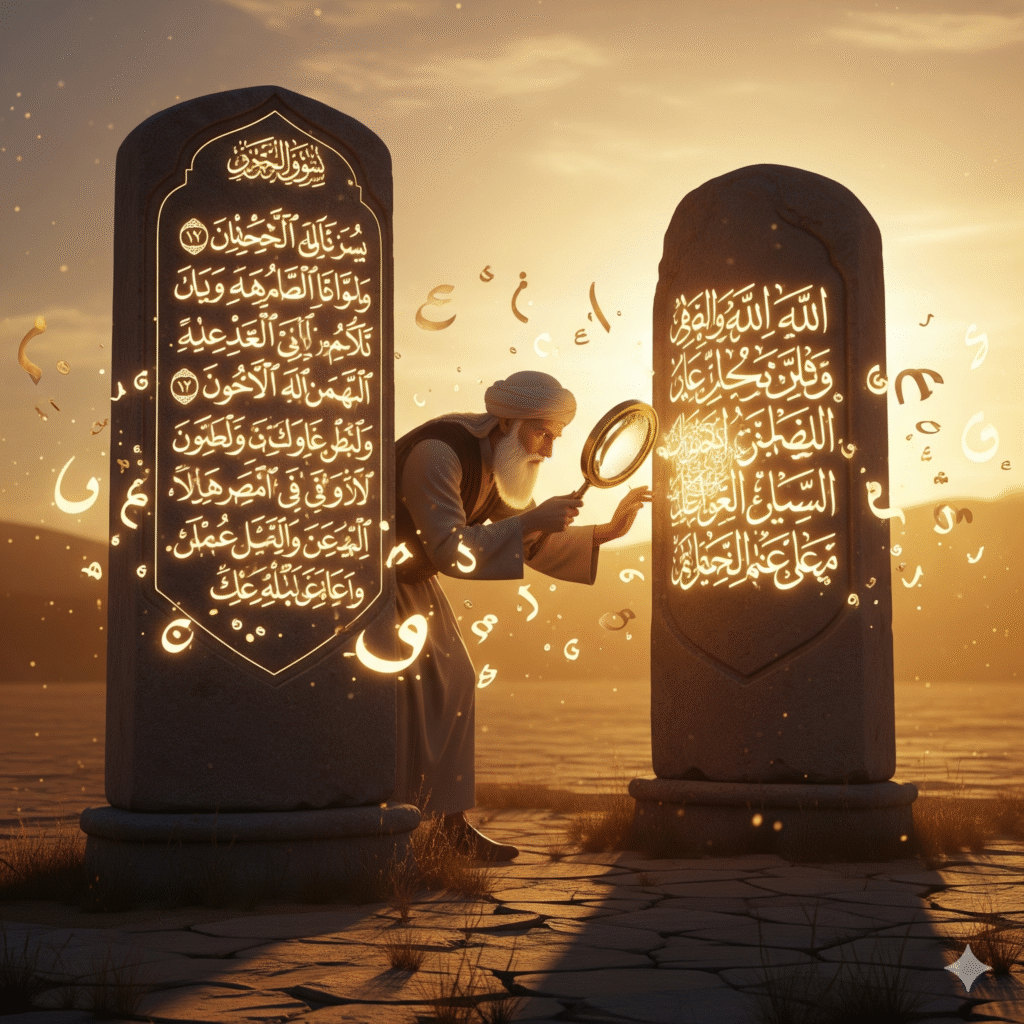
Example 2 (Surah Al-Ahzab, Verse 68):
Hafs Text: Employs the modifier “كَبِيرًا” (Kabeera), meaning: “…and curse them with a great curse.” Warsh Text: Employs the modifier “كَثِيرًا” (Katheera), meaning: “…and curse them with many/numerous curses.”
A Critical Logical Question: > These textual realities demonstrate that the narrative of a singular, globally standardized word-for-word text is an administrative and apologetic construct rather than a historical fact. When two officially printed versions differ across 1,300 variants—fundamentally altering descriptions from a prophet ‘surviving a battle’ to being ‘slain’—the claim of a perfectly preserved text down to the letter faces an insurmountable empirical challenge.
As prominent contemporary Muslim scholar Dr. Yasir Qadhi candidly admitted in his well-known interview (“The Crisis of Knowledge”): “The simplified narrative we give to the masses about the preservation of the Qur’an is not historically accurate when compared to real facts. There are clear holes in the standard narrative that cannot be hidden from advanced students of Islamic studies.”
6. Archaeological and Textual Evidence: The Sana’a Palimpsest and Early Scriptural Alterations
The textual variations and gradual modifications within the written Qur’an are verified not only by canonical Hadith literature but also by modern archaeological discoveries and classical Islamic linguistic treatises.
A. The Sana’a Palimpsest (Sana’a Manuscripts – 1972)
The Discovery: In 1972, during the restoration of the Great Mosque of Sana’a in Yemen, thousands of ancient Quranic parchment fragments were discovered hidden between the inner and outer ceilings. These are collectively referred to as the “Sana’a Manuscripts.”
Scientific Analysis: When the German scholar and expert in ancient Arabic paleography, Dr. Gerd-R. Puin, subjected these fragments to detailed carbon-dating and Ultraviolet (UV) light analysis, he discovered that the manuscript was a Palimpsest. This means it was a parchment sheet where the original, older text (Lower Text) had been chemically washed out and scraped away so that a newer, revised text (Upper Text) could be written over it.
The Outcome: Under UV light, the erased Lower Text became visible, revealing that it differed significantly from the standardized modern Uthmanic Qur’an in terms of spelling, word choice, sentence structure, and the sequence of the chapters (Surahs).
Divergent Scholarly Perspectives and Interpretations:
The Traditional Islamic View:Modern Islamic scholars and commentators argue that the Lower Text of the Sana’a palimpsest represents one of the companion codices written in a permitted Ahruf (tribal dialect) authorized by the Prophet. According to them, once the entire Muslim community (Ummah) achieved consensus on a unified text under Caliph Uthman, the obsolete variant was naturally erased to overwrite it with the official Uthmanic standard text, thereby demonstrating the continuity of divine preservation.
Critical Academic Evaluation (The Spectrum of Scholarship):Secular academia offers distinct, text-critical interpretations regarding this monumental archaeological find:
Dr. Gerd-R. Puin: In his research (“Observations on Early Quranic Manuscripts”), he concluded that these manuscripts empirically demonstrate that the Quranic text was fluid and unstable during the early Islamic period. It underwent a process of gradual evolution and human editorial modifications before being locked into place much later by state authority and political standardization.
Behnam Sadeghi and Uwe Bergmann: Their extensive structural analysis verified that while the Lower Text is indisputably different from the Uthmanic standard, it represents a highly authentic independent companion codex (analogous to the lost collections of Ibn Mas’ud or Ubayy) that existed prior to Uthman’s centralization.
Marijn van Putten and Nicolai Sinai: These historical linguists maintain that the Sana’a manuscript highlights a reality of textual fluidity in early Islam, proving that the rigid text observed today is the byproduct of comprehensive linguistic and political engineering executed over the initial centuries.

A Critical Logical Question:
Textual critics raise a vital inquiry: If the hidden Lower Text was an equally valid, divinely sanctioned revelation (Ahruf), why did human actors find it necessary to apply chemicals to completely erase it? Scrapping away an authentic component of divine speech to replace it with another text strongly indicates that the writing of the Qur’an was not a purely spiritual process; rather, it was a rigorous program driven by political and imperial necessities enforcing strict ideological and editorial control.
B. Complementary Historical Evidence: Ancient Recensions and Structural Changes
Beyond the Sana’a palimpsest, several other physical manuscripts and classical Islamic source texts confirm that the early written text experienced human interventions, losses, and localized structural evolution:
The Witness of the Blue Qur’an: Folios of the famous 9th-century ‘Blue Qur’an’ can be openly examined on the internet and in global museums. Written entirely without diacritical dots (Nuqte) or short vowel markers (I’rab), this manuscript stands as tangible physical proof that the early written medium lacked the flawless precision and absolute phonetic standardization claimed by modern apologists.
Academic Admission by Imam Al-Suyuti: One of the most celebrated and authoritative encyclopedists of Islamic tradition, Al-Suyuti, explicitly admits in his classical masterwork, ‘Al-Itqan fi ‘Ulum al-Qur’an’ (The Perfect Guide to the Sciences of the Qur’an), that portions of the original Quranic text had been permanently lost or destroyed over time due to human and natural contingencies.
Ancient Accounts from the Companions (Via Abu Ubaid): The classical Islamic historian Abu Ubaid, in his foundational work ‘Kitab Fada’il al-Qur’an’ (The Virtues of the Qur’an), records an extraordinary and highly critical historical statement:“Ibn Umar (the son of Caliph Umar) stated: ‘Let none of you say that he has acquired the entire Qur’an, for how does he know what the whole of it was? Much of the Qur’an has already disappeared (or been lost).'”
Comprehensive Compilations of Textual Variants: Comprehensive ancient and modern text-critical compendiums, such as the ‘Mu’jam al-Qira’at’ (The Encyclopedia of Quranic Recitations / Variant Collection), map out thousands of documented textual adjustments. These entries provide granular evidence showing exactly how specific words, letters, and grammatical templates of the Qur’an were systematically reshaped by human editorial decisions over time.
7. The 1924 Cairo Edition: The History of Modern Standardization
The uniform textual layout of the ‘Hafs’ Qur’an printed and distributed among Muslims worldwide today does not stem from antiquity; rather, its origin is relatively recent. It was a modern bureaucratic effort executed in 1924 CE by the government of Egypt and Al-Azhar University.
The Traditional Islamic View:
Traditional scholars maintain that the 1924 Cairo Edition was not a new Qur’an. Instead, they view it as a sacred endeavor to present the ancient Uthmanic orthography and the authentic oral transmission of ‘Hafs an ‘Asim’ in an ideal, error-free format utilizing modern printing technology.
Critical Academic Evaluation (Backed by Solid Sources):
According to historians of textual transmission – such as the reports compiled by the famous textual critic Arthur Jeffery and contemporary researchers of Islamic studies – up until the 19th and early 20th centuries, various Qur’ans with differing scripts (Orthography) and readings were being taught across different Muslim provinces and seminaries. This variation led to major administrative disputes regarding textual accuracy among students sitting for government examinations.
To eliminate this chaotic administrative inconsistency, the Egyptian government formed an official committee in 1924, selected the Hafs transmission, and drafted a standardized modern print layout based upon it.
The Academic Context of Destroying Variant Copies in the Nile River:
Historians and contemporary researchers (such as the accounts documented by Gotthelf Bergsträsser) have recorded that following the publication of this new official government edition, the Egyptian state took rigorous steps to maintain administrative uniformity and permanently eliminate future disputes. The government systematically collected thousands of copies of alternative, regional printed Qur’ans containing variant scripts or readings and destroyed them by drowning them en masse in the Nile River. This modern Egyptian administrative edition was subsequently adopted by Saudi Arabia, which propagated it globally through the King Fahd Printing Press.
A Critical Logical Question:
This historical and administrative event strongly indicates that the global textual uniformity observed in the Qur’an today is not the byproduct of a supernatural miracle of preservation, but rather the direct result of modern 1924 Egyptian government censorship and the administrative force utilized to destroy variant copies in the Nile River. If the Qur’an had always been word-for-word identical and perfectly secure, why did the premier intellectual center of the Islamic world (Egypt) face a rigid political necessity to have alternative versions cast into a river a mere century ago?
8. Conclusion: Evaluating the Historical Evidence
The cumulative data gathered from historical, linguistic, and archaeological analyses can be systematically summarized through the following framework:
| Historical / Textual Evidence | Supports the Claim of Perfect, Letter-for-Letter Textual Preservation? |
| Abu Bakr’s Compilation (Yamama War) | No. Confirms the text was uncompiled during the Prophet’s life and that the companions experienced an acute, human fear of its structural loss. |
| Primitive Script (Skeleton Rasm) | No. The lack of diacritical dots and vowel markers in early Arabic naturally opened multiple paths for conflicting words and definitions. |
| The Uthmanic Purge (Burning Manuscripts) | No. Documents a centralized state program of strict censorship where the alternative written collections of the closest companions were forcibly burned. |
| Missing Sections (Rajam & Breastfeeding) | No. Supported by Sahih Hadith and contemporary legal practices, this points directly to the physical loss of original legislative content. |
| Companion Codices (Disputed Surah Counts) | No. Proves that the Prophet’s elite scriptural teachers held deep disagreements over whether the Qur’an contained 111, 114, or 116 chapters. |
| Hafs vs. Warsh (1,300 Lexical Differences) | No. Empirically demonstrates that different printed versions with contradictory meanings continue to coexist globally. |
| Sana’a Palimpsest & the 1924 Cairo Print | No. Provides physical and bureaucratic proof that the modern text is the final result of systematic human editing, erasure, and state-enforced printing monopolies. |
Final Conclusion
A comprehensive analysis of primary Islamic documentation, cross-tradition Hadith contradictions, historical linguistics, and physical archaeological discoveries demonstrates that the traditional narrative claiming the Qur’an has been preserved perfectly down to a single letter or vowel marker is completely unsupported by historical evidence.
The text available today is not the product of a supernatural, unvaried miracle. Instead, it is the historical result of early tribal disagreements, intense state-managed censorship during the Uthmanic era, the inherent structural limits of primitive scripts, and the centralized bureaucratic filtering of the 1924 Egyptian government. This historical reality places a profound, unresolved challenge before the claims of absolute scriptural preservation.
Do you still believe that the Quran is perfectly preserved? 🤔
📢 Did you find this article useful?
🙏 Support our work by clicking here.