
(A Critical, Referenced Analysis of Islamic Expansionist Theology)
Introduction: The Fundamental Structural Framework
The theoretical and practical definition of Islam is not determined by subjective or contemporary interpretations, but by its two immutable primary sources: the Quran (the verbatim word of God) and the Sahih Hadith (the verified actions and sayings of Prophet Muhammad). According to classical Islamic jurisprudence (Fiqh), the commands contained within these texts constitute an absolute Farz (obligatory duty) upon every Muslim, and the behavioral models established in the Hadith are classified as Sunnah (the ideal path for humanity).
Within the orthodox framework of Islamic theology, an individual who does not fully adhere to these established decrees, or who adopts a selective approach toward them, is not classified as a complete believer. Instead, in the precise vocabulary of Sharia, such individuals are designated under the categories of ‘Munafiq’ (hypocrite) or ‘Murtadd’ (apostate).
Consequently, concepts such as Jihad, Dar al-Islam, Taqiya, Hudna, Jizya, and the Caliphate are not secondary, optional, or merely spiritual allegories. Rather, they serve as the foundational pillars of a highly coordinated institutional and strategic blueprint. When a religious philosophy restricts its scope solely to individual spiritual salvation, its discourse remains confined to the soul and the metaphysical realm. However, the moment a belief system begins to enforce a comprehensive legal code (Sharia), governance models, judicial administration, and explicit rules of engagement or military strategy, it transcends the definition of a conventional “religion.” It transforms fundamentally into a totalizing geo-political ideology.
1. Dar al-Islam vs. Dar al-Harb: The Binary Geopolitical Division
Classical Islamic jurisprudence divides the entire globe into distinct geopolitical zones. Within this dogmatic framework, there is no conceptual validation for modern secular ‘nationalism’, patriotism, or sovereignty based on man-made geographical borders.
Evidences from Primary Jurisprudence:
Al-Hidayah (Imam Al-Marghinani, 12th Century, Hanafi Fiqh): This foundational text of legal jurisprudence asserts that the classification of a territory depends entirely on the system of law that holds absolute sovereignty over it.
Ibn Taymiyyah (Majmu’ al-Fatawa): His treatises on Jihad and political authority explicitly define the expansion of Islamic political rule over non-Muslim lands as a foundational religious obligation.
Islam, especially in its Sharia-centric form, contains several principles that go beyond faith – into the realm of territorial conquest, cultural supremacy, and civilizational domination.
- The Core Geopolitical Concepts:
- Dar al-Islam (The Abode of Islam): Territories where Islamic Sharia law is actively enforced, supreme, and politically sovereign.
- Dar al-Harb (The Abode of War): Any territory or nation where Sharia law is not implemented. According to classical doctrine, bringing these regions under the political and legal subjugation of the Ummah (the global Muslim community) is the ultimate collective objective.
- Additional Authoritative Reference:Imam Al-Shafi’i (Kitab al-Umm): “The foundational rule is that a state of conflict remains implicit with Dar al-Harb until its inhabitants either accept Islam or submit to the status of subjugation by paying the Jizya.”
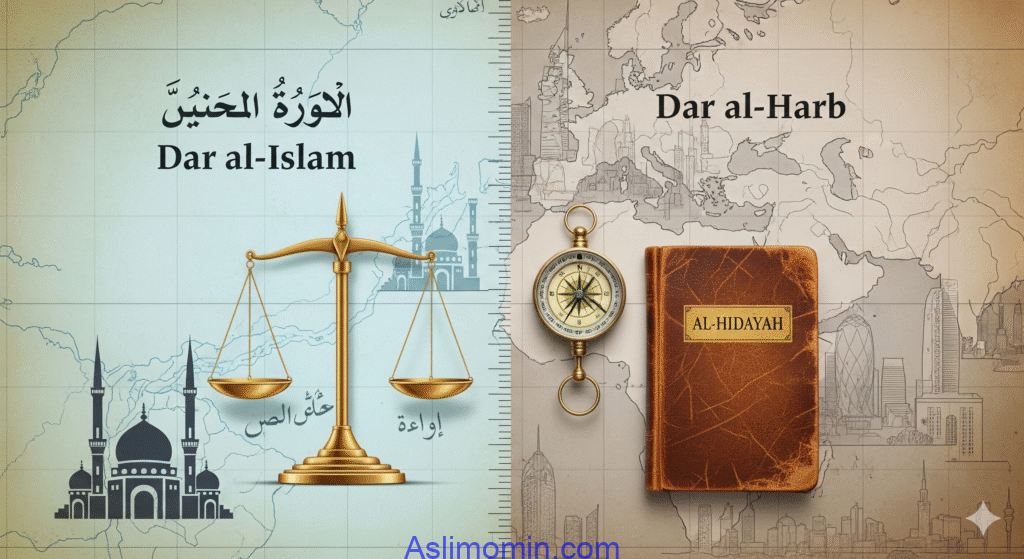
“The abode where the laws of Islam prevail is Dar al-Islam. The rest is Dar al-Harb until Islam reaches it.” — Al-Hidayah
Strategic Conclusion: Under this ideological framework, a conservative Muslim’s ultimate, uncompromised loyalty belongs not to a secular nation-state, a geographical homeland, or a human-written constitution, but exclusively to the Ummah and the global implementation of Dar al-Islam.
2. Jihad: Spiritual Striving or Institutionalized Expansionism?
While modern apologists frequently attempt to rebrand Jihad exclusively as an “internal or spiritual struggle,” the primary textual sources (Nass) of Islamic theology establish it unambiguously as a calculated political and military instrument.
Scriptural Evidences from the Quran:
Surah At-Tawbah (9:5) [The Verse of the Sword]: “And when the sacred months have passed, then kill the polytheists wherever you find them and capture them and besiege them and sit in wait for them at every place of ambush…”

Surah At-Tawbah (9:29): “Fight those who do not believe in Allah and the Last Day… and who do not adopt the religion of truth [Islam] from among those who were given the Scripture [Jews and Christians] until they pay the Jizya willingly while they are humbled (subjugated).”
Surah Muhammad (47:4): “So when you meet those who disbelieve [in battle], strike at their necks until, when you have thoroughly subdued them, then bind them firmly…”
Evidences from the Sahih Hadith:
Sahih al-Bukhari (Hadith 25): The Messenger of Allah said: “I have been commanded to fight against people so long as they do not bear witness that there is no god but Allah and that Muhammad is the Messenger of Allah…”
Sahih Bukhari 25 (Scan from sunna.com)
Sahih Bukhari 6924 (Scan from sunna.com)
Strategic Conclusion: These primary textuary metrics demonstrate that the institutionalized manifestation of Jihad is not self-defense or abstract morality, but an aggressive, expansionist military doctrine designed to dismantle non-Islamic political systems and establish theological hegemony.
3. Taqiya and Hudna: Tactical Deception and the Metrics of Truce
When Islamic political or military power is in a state of numerical or strategic inferiority, the doctrine does not demand unconditional surrender or permanent pacifism. Instead, it deploys sophisticated mechanisms of tactical deception and strategic patience.
- Taqiya (Strategic Dissimulation / Concealment of Intent):
- The Quran (3:28): “Let not believers take disbelievers as allies rather than believers… unless you indeed fear a danger from them and seek a means of self-defense (Tuqat / Taqiya).”
- Exegesis Reference (Tafsir Ibn Kathir): In explaining this verse, Ibn Kathir quotes the prominent companion Abu Darda: “We smile in the faces of certain people while our hearts curse them.”
- Hudna (Tactical Truce for Regrouping):
- Historical Precedent (Treaty of Hudaybiyyah – 628 CE): Prophet Muhammad entered into a 10-year peace treaty with the Quraish of Mecca. However, as soon as the Muslim military apparatus achieved strategic superiority, the treaty was effectively bypassed within two years, culminating in the complete conquest of Mecca in 630 CE.
- Jurisprudential Rules: According to Hanafi and Shafi’i legal schools, no peace treaty with non-Muslims can be ‘permanent’ in nature. Following the prophetic precedent of Hudaybiyyah, a Hudna can be maintained for a maximum of 10 years, serving exclusively as a mechanism to gather strength, resource, and tactical advantage.
➡ These doctrines legitimize temporary peace and religious concealment until Muslims gain strength – then nullify the agreement.
Strategic Conclusion: Within Islamic strategic thought, ‘peace’ is never an ultimate geopolitical end; it is a fluid military tactic (Warfare Strategy) utilized when the community is weak. The moment power equilibrium shifts, terminating the truce to assume an offensive posture is fully sanctioned by law.
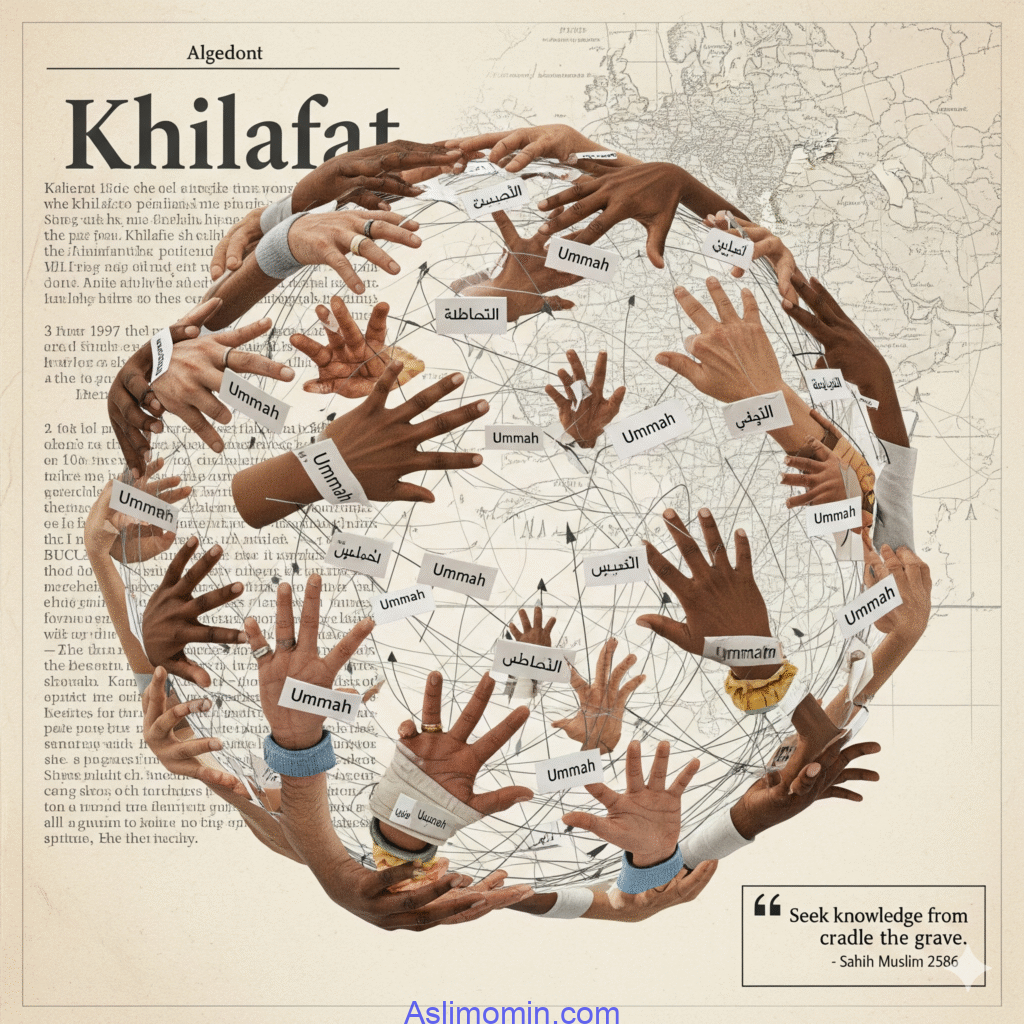
4. The Caliphate and the Ummah: The Sovereign Model of Universal Subjugation
Islam advocates for a globalized political structure wherein human society is consolidated under a single, centralized, and non-secular authority that merges both religious and political supremacy.
- Evidences from the Texts:
- Sahih Muslim (Hadith 2586): “The Muslims are like a single body; if the eye smarts, the whole body suffers…”
- Abul A’la Maududi (Khilafat o Malookiat): Maududi delineates that the terminal objective of Islam is not the preservation of democratic nation-states, but the absolute implementation of Allah’s absolute sovereignty across the earth through the vehicle of the Caliphate.
Sahih Muslim 2586 (Scan from sunna.com)
Strategic Conclusion: The concept of the Ummah systematically invalidates modern definitions of citizenship, patriotism, and secular statehood. Its terminal political milestone is a universal Caliphate, before which all national borders, local laws, and alternative sovereign structures must yield.
5. Policy Towards Non-Muslims: Jizya, Dhimmitude, and Institutional Subjugation
Under the jurisdiction of Sharia law, there is no conceptual equivalence of universal human rights or equal citizenship for non-Muslims within a conquered territory. Non-Muslim subjects (termed as Dhimmis) are relegated to a deliberately humiliated and secondary social tier.

- Textual Evidences:
- The Quran (9:29): The text explicitly dictates that military subjugation must persist until non-Muslims pay the Jizya tax directly from their hands while remaining Saghiroon (utterly humbled, brought low, and degraded).
- Historical Evidence (The Pact of Umar / Shurut Umariyyah): Attributed to the second Caliph, Umar ibn al-Khattab, this historic pact imposed draconian restrictions on non-Muslims (Christians and Jews). They were forbidden from building new places of worship, banned from displaying religious symbols publicly, and legally compelled to stand up in deference whenever a Muslim wished to sit.
- The Blueprint for Polytheists (Hindus, Buddhists, etc.):
- According to classical Islamic jurisprudence (especially within the stricter Shafi’i, Maliki, and Hanbali schools), the concession of paying Jizya was natively reserved only for Ahl al-Kitab (People of the Book – Jews and Christians). For polytheists, iconoclasts, and pagans, the jurisprudential standard recognized only two choices: Conversion to Islam or Death by the Sword. (While certain Hanafi rulers in medieval India practically extended the Dhimmi status to Hindus for administrative and economic feasibility, the orthodox theological paradigm always maintained their intrinsic status as a subjugated group).
6. Islamic Triumphalism: The Doctrine of Ultimate Conquest
Islam does not view its relationship with other religious or philosophical systems through the lens of permanent pluralistic ‘co-existence’. Its self-declared mandate is absolute supremacy over all alternative worldviews.
- Scriptural Evidences from the Quran:
- Surah At-Tawbah (9:33) and Surah As-Saff (61:9): “It is He who has sent His Messenger with guidance and the religion of truth to manifest it over all religion, clear of how much the polytheists may detest it.”
- Philosophical and Historical Assessment:
- Ibn Khaldun (Al-Muqaddimah): The foundational Islamic historian and philosopher explicitly notes that whereas other religious denominations restrict warfare to defensive scenarios, the Islamic Ummah is unique because it possesses a divine mandate to aggressively establish political dominance over all other nations.
7. The Graduated, Three-Phase Strategy of Expansion
A chronological mapping of Prophet Muhammad’s life – from the early days in Mecca to the ultimate consolidation of power in Medina (Seerat-un-Nabi) – reveals a highly systematic, graduated operational methodology (Modus Operandi):
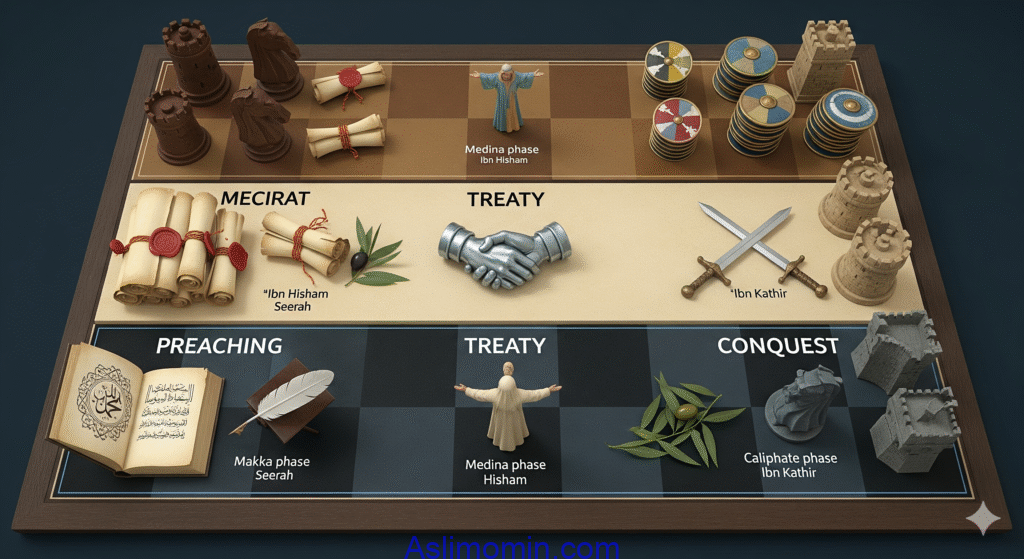
➡ Islamic strategy follows a three-phase model:
[Phase 1: Minority Status / Weakness] ──> Pacifism, Toleration, and Proseylitization (“To you your religion…”)
▼
[Phase 2: Transition / Strategic Balance] ──> Defensive Militancy, Tactical Alliances, and Consolidation
▼
[Phase 3: Majority Status / Absolute Power]──> Aggressive Warfare, Destruction of Idols, and Total Subjugation
The Meccan Period (Strategic Infinitude): The Quran (109:6) – “To you be your religion, and to me my religion.” This pacifist model was applied because the Muslim community lacked the numbers, political infrastructure, and military capability to challenge the existing status quo.
The Medinan Period (Sovereign Dominance): The Quran (9:5) – “Kill the polytheists wherever you find them…” In Islamic jurisprudence, this later, highly aggressive text invokes the legal doctrine of ‘Nasikh wa Mansukh’ (The Principle of Abrogation), effectively nullifying and replacing the earlier, peace-oriented verses uttered during the period of political vulnerability.
Conclusion: The Strategic Matrix of a Religious Empire
Through a rigorous lens of geopolitical and strategic analysis, the core religious doctrines of Islam and their corresponding real-world operational objectives can be synthesized as follows:
| Islamic Theological Doctrine | Geopolitical / Strategic Objective |
| Dar al-Islam / Dar al-Harb | Complete rejection of secular nationalism and constitutional boundaries in favor of Sharia expansion. |
| Jihad (Qital) | The deployment of calculated kinetic force to dismantle non-Islamic states and seize political power. |
| Taqiya / Hudna | Deceptive diplomacy and temporary ceasefires to build capability when the balance of power is unfavorable. |
| The Caliphate / Ummah | Geopolitical polarization to unify global Muslim loyalty under a singular transnational political entity. |
| Jizya / Dhimmi Status | Economic exploitation and deliberate socio-legal humiliation to permanently cripple non-Muslim resistance. |
| The Three-Phase Method | Fluid shifts between ‘peaceful dialogue’ and ‘uncompromising warfare’ based entirely on demographic strength. |
| Islamic Triumphalism | The ultimate eradication, assimilation, or absolute subjugation of all alternative human cultures and philosophies. |
The Core Textual Imperative
According to the unalterable framework of orthodox Islamic theology, Islam is fundamentally defined by what is explicitly codified in its primary canons – the Quran and the Hadith. The authority to dilute, gloss over, or abrogate these expansionist and strategic parameters does not belong to any ordinary Muslim, secular reformer, or modern academic. Anyone who rejects, minimizes, or contextually filters out these explicit political and military mandates in response to modern secular values automatically slips out of the boundaries of classical orthodox jurisprudence. Consequently, evaluating Islam as a mere system of personal spirituality is a flawed academic exercise; it is far more textually accurate to analyze it as a comprehensive, expansionist, and highly sophisticated manual for a global political-military empire.
📢 Did you find this article useful?
🙏 Support our work by clicking here.