
Introduction
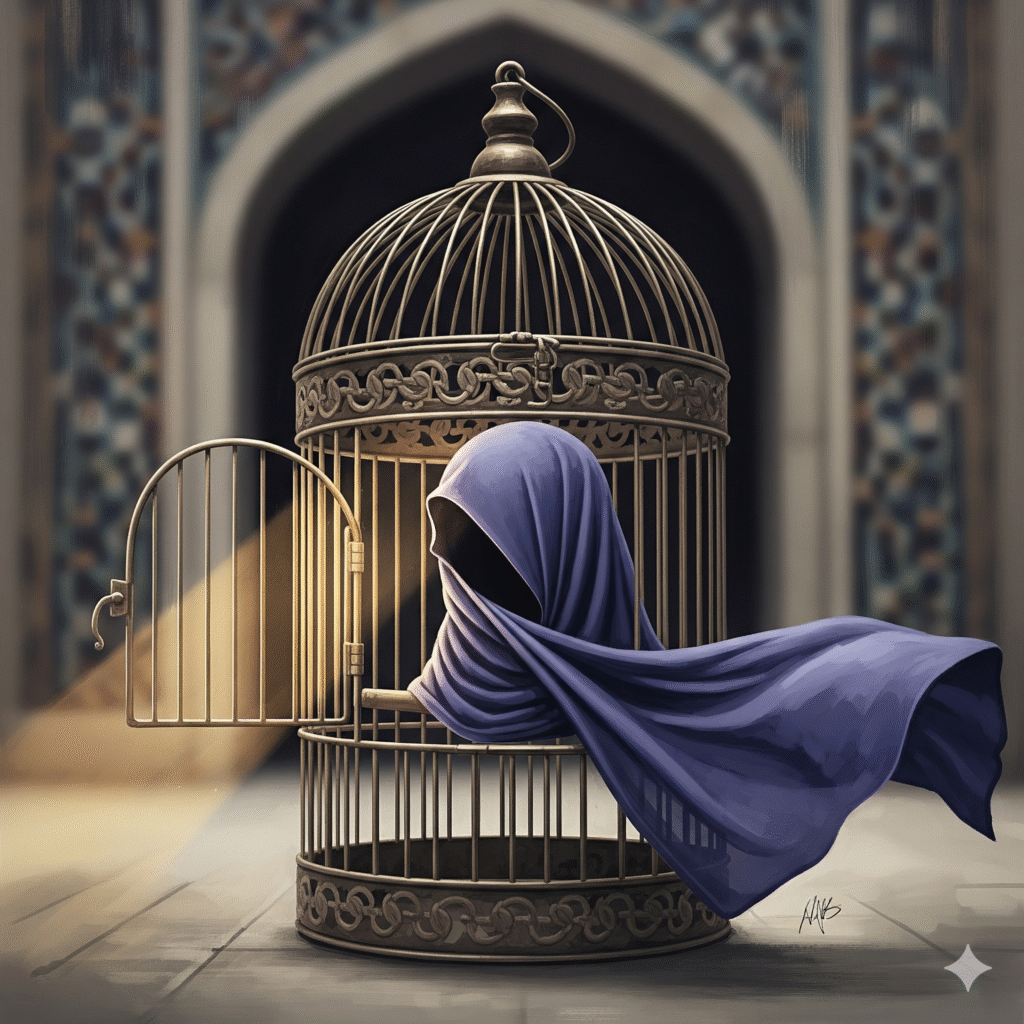
Clerics present the hijab as a symbol of “women’s protection and honor” and describe it as a “blessing” from Allah. But was it truly meant for protection, or was it merely a result of male desire and societal pressure? The Quran and Hadith indicate that the hijab was not a divine favor, but a tool to confine women. Let us break this facade and uncover the truth.
Part 1: The Verse on the Hijab — Why and How?
1.1 The Reality of the Situation
Fourteen hundred years ago, there were no proper toilets in Arabia. Women went out at night to open fields—Sahih Bukhari (148 & 6240) records Hazrat Aisha stating that the Prophet’s wives used to go to the “al-Manasi” field, and Umar ibn al-Khattab would see them and harass them.
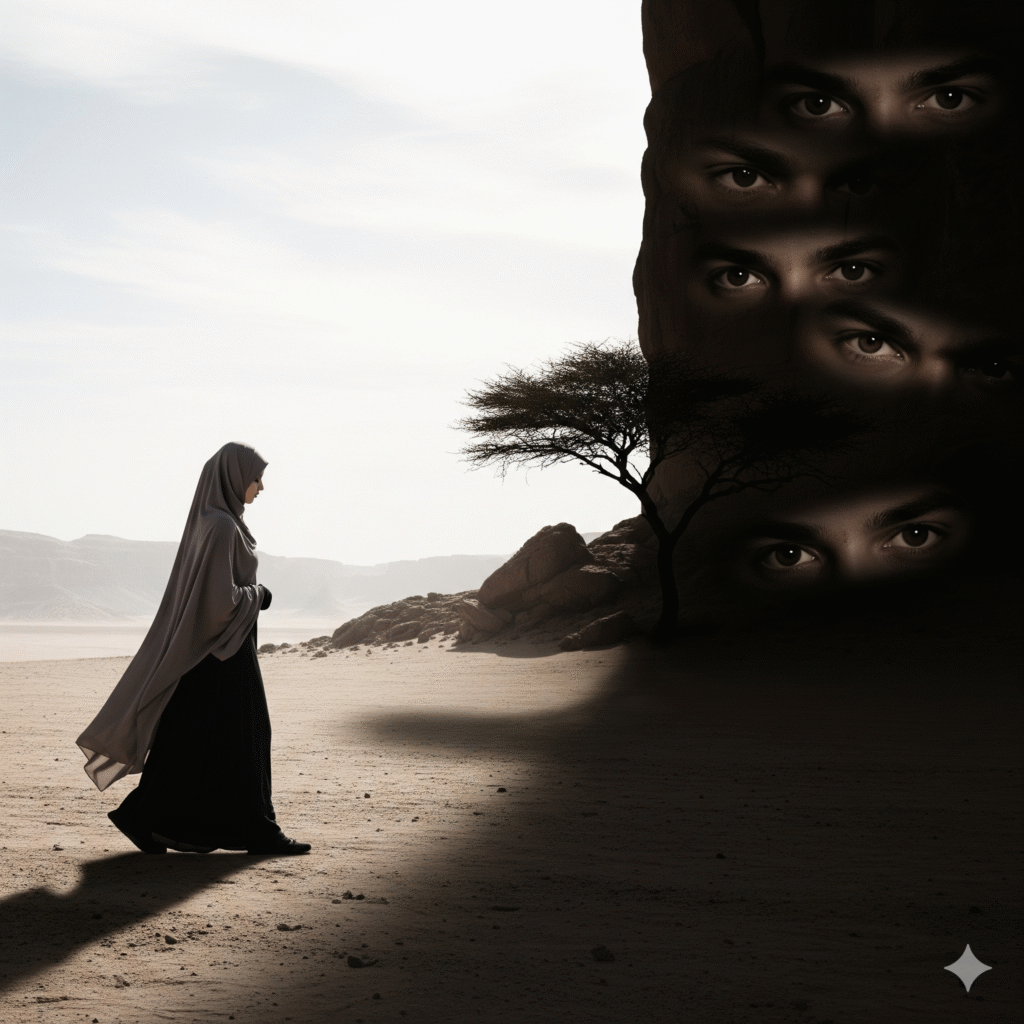
Umar repeatedly said, “Keep your wives under cover.” The Prophet initially postponed implementing this.
Sahih Muslim (Hadith 2170A and 2170D) mentions that one night Umar recognized and harassed Sauda bint Zam’a—saying, “Sauda, we have recognized you.”
Sauda complained to Prophet Muhammad (ﷺ). The Hadith clearly indicates that Umar’s behavior created pressure for the revelation of the verse on the hijab.
Here, however, two crucial questions arise:
When Sauda complained, the Prophet was eating meat with a bone in his hand. Even hearing this complaint did not anger him. Instead of reprimanding Umar, the verse on the hijab was revealed.
Does this not suggest that verses were not revealed solely by Allah’s will, but that influential men—like Umar—could, through their desire and pressure, influence religious directives?
And immediately, the verse was revealed—Surah Al-Ahzab (33:59):
“Tell your wives, daughters, and the women of the believers to draw their cloaks over themselves.”
Ibn Hisham’s Sirat Rasul Allah (p. 290) also confirms this.
This raises the question of the actual reason behind the hijab and its historical circumstances. Could it be that the veil was imposed on women solely due to male desire and social pressure?
1.2 The Facade of Protection
Clerics claim it was to protect women from the “evil eye.”
But this raises a question: when this verse was revealed, most people in Medina were Muslims—so whose “evil eye” needed protection? Were the Muslim companions themselves gazing at women lustfully?
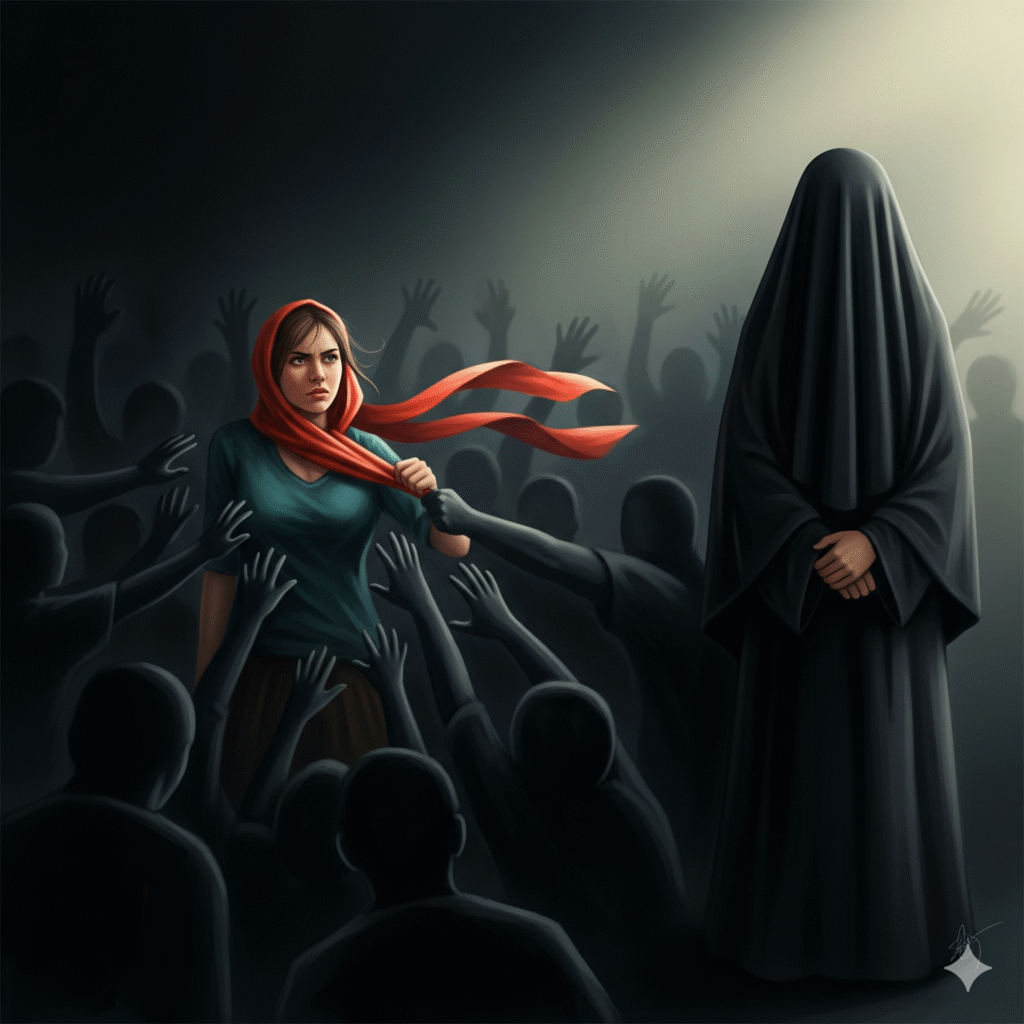
Sahih Bukhari (Hadith 148) records Umar saying, “Women are exposed,” clearly showing that the threat was not from outsiders, but from within.
When the verse was revealed, all were Muslims—so whose evil eye was it supposed to protect women from? The answer is evident: from the men of Islam themselves.
Part 2: Protection or Restriction?
2.1 The Real Purpose
If a man harassed a woman, should the punishment fall on him, or should the woman be confined? Islam chose the latter path.
Surah An-Nur (24:31) commands women to “lower their gaze” and “cover themselves with a cloak,” whereas men are only instructed to “lower their gaze” in Surah 24:30—a moral directive without legal penalty.
Sahih Bukhari (Hadith 6240) makes it clear that Umar’s harassment was the very reason for the revelation of the verse on the hijab. Sunan Abu Dawood (Hadith 4102) also records men’s indecent behavior, but no punishment was prescribed.
Islamic sources indicate that at the time, Arab men could not control their sexual desires. Sahih Muslim (1403A) narrates that the Prophet saw a woman in the market and later went to his wife Zainab, who was working with leather. After satisfying his desire, he reportedly said:
“A woman comes as a temptation (Shaytan).”
Even a woman walking in the market could arouse men, and the blame was placed on women, labeling them as Shaytan.
2.2 Umar’s Pressure
The Prophet initially did not deem covering necessary. Sahih Bukhari (Hadith 146) records Umar’s insistence:
“Women go out; cover them.”
Only after Sauda’s complaint was the verse revealed. Al-Tabari’s Tarikh (Vol. 2, p. 402) also confirms the evident pressure from Umar.
Sahih Muslim (Hadith 3240, International No. 1400) quotes the Prophet:
“A woman comes in front as Shaytan and goes behind as Shaytan. When a man sees a woman and feels attracted, he should go to his wife or servant to satisfy his desire.”
The meaning is clear—if men could not control their desires, the fault was assigned to women.
Part 3: The Dark History of the Hijab
3.1 The Reality of Jahiliyyah
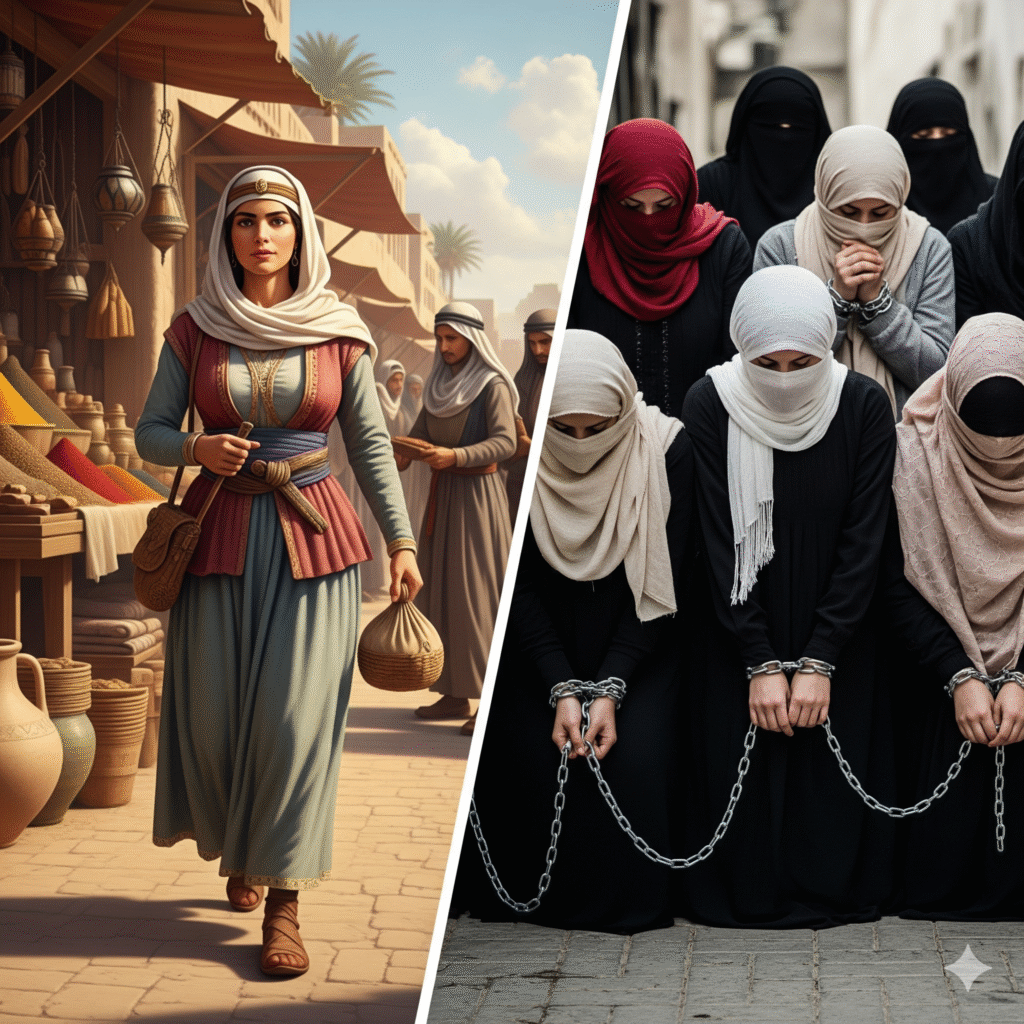
Khadijah conducted business freely without any veil. Many other women in Arabia were socially and politically independent. Examples include:
- Queen Bilqis of Sheba (Quran, Surah An-Naml 27:23–44)
- Queen Safiyyah of Banu Qurayza
- Maymunah of Banu Hashim, whom Muhammad proposed to gift himself, but she replied, “A queen does not gift herself.”
- Other queens like Umme Kirfa
However, after the advent of Islam, these women were confined.
Sahih Muslim (Hadith 1860) notes that even the Prophet’s daughter Fatima faced restrictions—she was deprived of what Muhammad had granted her, such as the Fadak garden (Sahih Bukhari, Hadith 4241). Her home door was broken, and her house was set on fire. According to historians and Hadith, this caused Fatima a miscarriage and inflicted physical and mental trauma, contributing to her eventual death.
3.2 The Attitude of the Companions
Sahih Bukhari (Hadith 402) records that when a man looked at one of the Prophet’s wives, he was only reprimanded—no punishment was given.
Umar’s harassment of Sauda shows that the “evil eye” came from Muslim men themselves, and women were veiled to protect them from these men.
Ibn Saad’s Tabaqat (Vol. 8, p. 116) records similar incidents among the companions, proving that the real purpose of the hijab was to control women’s freedom, not to ensure their protection.
The Verse on the Veil and Sauda bint Zam’a: A Moral Paradox?
A question arises: was the woman who was granted exemption from the veil the very reason for the revelation of the hijab verse?
The Quran in 24:60 states:
“And for elderly women who no longer expect marriage, there is no blame upon them if they remove their outer garments, provided they do not display adornment.”
According to Ibn Kathir and other mufassirun, this exemption was intended for older women beyond sexual desire.
Sahih Muslim (Hadith 1463) notes that Sauda, fearing that the Prophet might divorce her due to her advancing age, requested to give her turn to Aisha, saying she wanted her name to remain among his wives on the Day of Judgment.
The moral contradiction:
- The woman who was allowed to leave the veil (Sauda) — became the very reason for the revelation of the hijab.
- The woman whom Muhammad might have divorced — voluntarily gave her turn to Aisha to preserve her marital status.
This demonstrates that the verses on the veil were not about protecting a wife’s identity or honor, but about creating distance from young women.
Part 4: Conclusion — The Deception of the Hijab
The hijab was a facade of protection. It was not about safety, but an excuse for men’s lecherous gaze. Clerics wrapped it in the cloak of “honor” to evade criticism.
If male desire was the real issue, why did Allah—who threatens Hellfire at every minor sin—not punish them?
Why was there a verse on veiling instead of a verse prescribing punishment for misconduct?
The truth is: the hijab was a tool to confine women—do not mistake it for protection.
After this, no business tycoon like Khadijah or female rulers emerged in Arabia. Perhaps this was the intention: where men could not control themselves and labeled women as Shaytan, women were kept under cover.
In the Prophet’s words:
“The devil was covered.”
Zakir Naik also remarked:
“If your body does not stir after watching a female TV anchor for 20 minutes, you are not a real man.”
This illustrates why controlling male arousal was a challenge in that context.
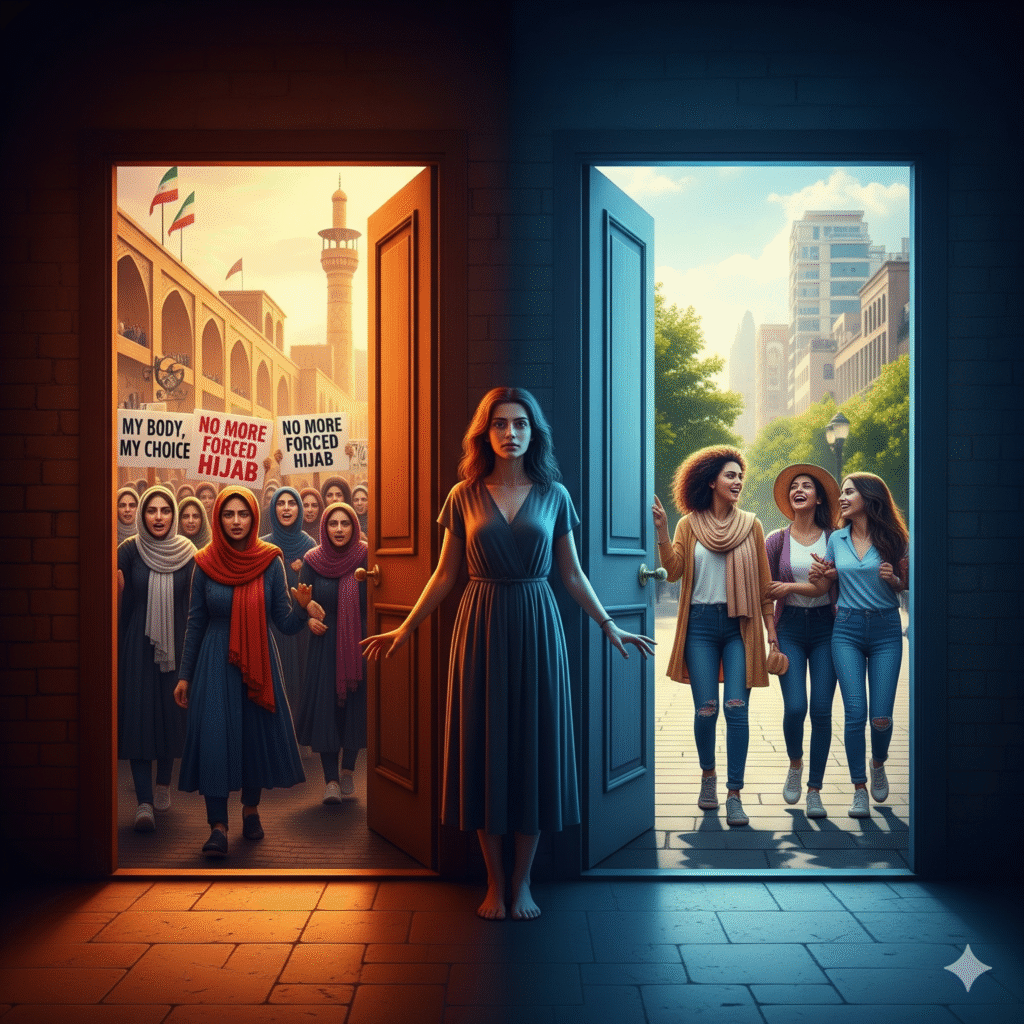
Today’s Concern: The Burden of Hijab
Look at the videos from Iran in the 1960s—women living freely without hijab. Compare that to present-day Iran, where women are fighting to be free from this enforced covering. Reports from various Muslim countries also highlight the same struggle.
On one side, Iran’s women demand liberation from hijab; on the other side, in India—where there is freedom to wear or not wear it—controversies and clashes erupt. Why? Because religious hardliners don’t want girls to step out freely, since they fear losing control and authority.
Even girls themselves start accepting hijab, not because of genuine choice, but because of the obsession that “pleasing Allah” means restrictions. Yet in countries where hijab is legally imposed, women are not happy. They resist.
But in places like India, Europe, and America, where there is no legal compulsion, Muslims are happy. In Islamic Sharia-ruled countries, however, Muslims are suffering. Just think: how necessary is hijab really?
When it comes to exams, voting, or religious debates, some push hijab as an identity. But at weddings or parties, many quietly set it aside. The truth is: the happiness and freedom of Muslim women are not linked to hijab, but to the absence of coercion.
Now you decide—how essential is hijab?
Part 5: Questions That Sting
- If the hijab was truly for protection, why was no punishment ordered for men?
- Were women chained to protect them from the “evil eye” of the companions?
- The verse was revealed after Umar’s harassment — was this Allah’s command, or Umar’s victory?
- Alcohol was made forbidden, so why not male desire?
- If someone harassed your daughter, would you punish him or cover her?
- If Allah is all-powerful, why were women crushed instead of men being controlled?
Conclusion:
The hijab is not a divine safeguard—it was a decree to make women subservient. History and Hadith bear witness to this. The rest—right or wrong—is left for you to decide.
📢 Did you find this article useful?
🙏 Support our work by clicking here.