

Family Background of Prophet Muhammad (ﷺ)
Prophet Muhammad’s (ﷺ) father’s name was Abdullah and his mother was Amina bint Wahb. His grandfather, Abdul Muttalib, was the custodian of the Kaaba and a prominent leader of the Quraysh tribe in Mecca. Abdul Muttalib had several sons, including Abdullah (Prophet’s father) and Hamza ibn Abdul Muttalib (the Prophet’s uncle). Genealogically, Hamza was his uncle, but since their birth timelines were close, this forms the core of our investigation.
Introduction
The timeline of Prophet Muhammad’s (ﷺ) birth has long been a perplexing issue in Islamic historiography. Traditional accounts suggest that he was born a few months after the death of his father Abdullah, while his mother Amina was already pregnant.
However, upon closer examination of classical sources and fiqhi interpretations, it appears there might have been a 2 to 4 year gap between the Prophet’s birth and Abdullah’s death. Such a discrepancy challenges the natural duration of pregnancy (9–10 months) and compels Islamic jurists to entertain the idea of prolonged pregnancy (2–4 years) within Islamic legal reasoning.
Historical Basis
The notion of an unusually long pregnancy primarily arises from the age difference between Hamza ibn Abdul Muttalib and Prophet Muhammad (ﷺ), and the timeline of Abdullah’s death.

1. Time of Marriage and Hamza’s Birth
The most ancient and authoritative sources—Ibn Ishaq (Sirat Rasul Allah), Ibn Hisham (Sirat al-Nabawiyyah), and Ibn Sa’d (Tabaqat al-Kubra)—clearly state that the marriages of Abdul Muttalib and his son Abdullah took place on the same day.
- Abdul Muttalib married Halah bint Wahb, while Abdullah married Amina bint Wahb.
2. Age Difference Between Hamza and the Prophet
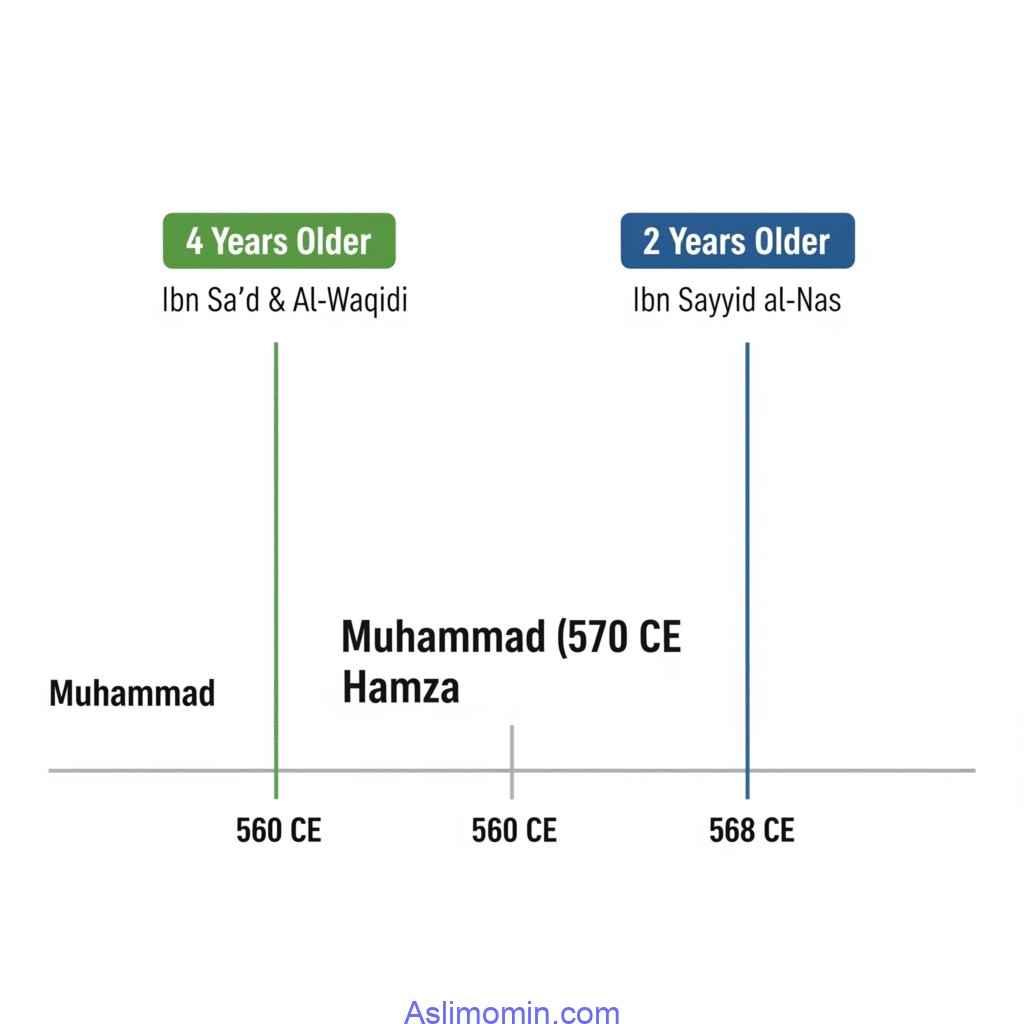
According to traditional claims, Hamza was 2 to 4 years older than the Prophet.
- Four years older:
“Ḥamzah was four years older than the Messenger of Allah”
— Ibn Sa’d, Tabaqat al-Kubra (citing Al-Waqidi) - Two years older:
According to Ibn Sayyid al-Nas, both Hamza and the Prophet were nursed by Thuwayba, the same wet nurse.
This would make a four-year age gap unrealistic, and he concluded that Hamza could be at most two years older.
— Uyūn al-Athar – Ibn Sayyid al-Nas
However, most early scholars supported the 4-year difference, including Ibn Abd al-Barr (Al-Istiʿāb).
3. Death of Abdullah
Narrations suggest that shortly after his marriage, Abdullah traveled to Syria (Sham) for trade and died on his return journey in Yathrib (Medina).
“The time Abdullah and Amina spent together was very short, as Abdullah soon departed for trade and died there.”
Sources:
- Ibn Sa’d – Tabaqat al-Kubra
- Ibn Hisham – Sirat Rasul Allah
- Al-Tabari – Tarikh al-Rusul wal-Muluk

The Core Problem
According to established facts:
- Abdul Muttalib and Abdullah were married on the same day.
- Hamza was 2–4 years older than Prophet Muhammad.
- Abdullah died shortly after marriage while on a trade trip.
When we align these facts, a chronological contradiction emerges.
If Halah (Abdul Muttalib’s wife) conceived immediately and gave birth in 9 months (as in the case of Hamza), and Amina conceived shortly after, the maximum age gap between Hamza and Muhammad should have been 4–6 months.
Even if Amina conceived during Abdullah’s final days before his journey, that would not support a 2–4 year age difference.
Hence, to accept the traditional claim that Hamza was 2–4 years older, one must assume that Amina carried Muhammad in her womb for 2 to 4 years—an assertion that is biologically implausible.

This is the crux of the dilemma:
If Hamza being 2 or 4 years older than Muhammad is true, then it forces the acceptance of a prolonged pregnancy for Amina, since Abdullah had already died and could not have fathered a child later.
Moreover, traditions affirm that Amina was already pregnant before Abdullah left for his trade journey.
Prolonged Pregnancy in Fiqh: A Legal Accommodation?
To resolve this contradiction, Islamic jurisprudence (fiqh) made room for unusually long pregnancies.
Sunni Madhhabs on Maximum Pregnancy Period:
- Hanafi: Up to 2 years — (citing Surah Ahqaf 46:15 and Luqman 31:14)
- Maliki, Shafi’i, Hanbali: Up to 4 years — (based on Al-Mudawwanah, Al-Umm, Musnad Ahmad)
Legal Examples from Fiqh:

“If a woman gives birth within two years of her husband’s death or absence, and there is no evidence to the contrary, the child will be considered legitimate.”
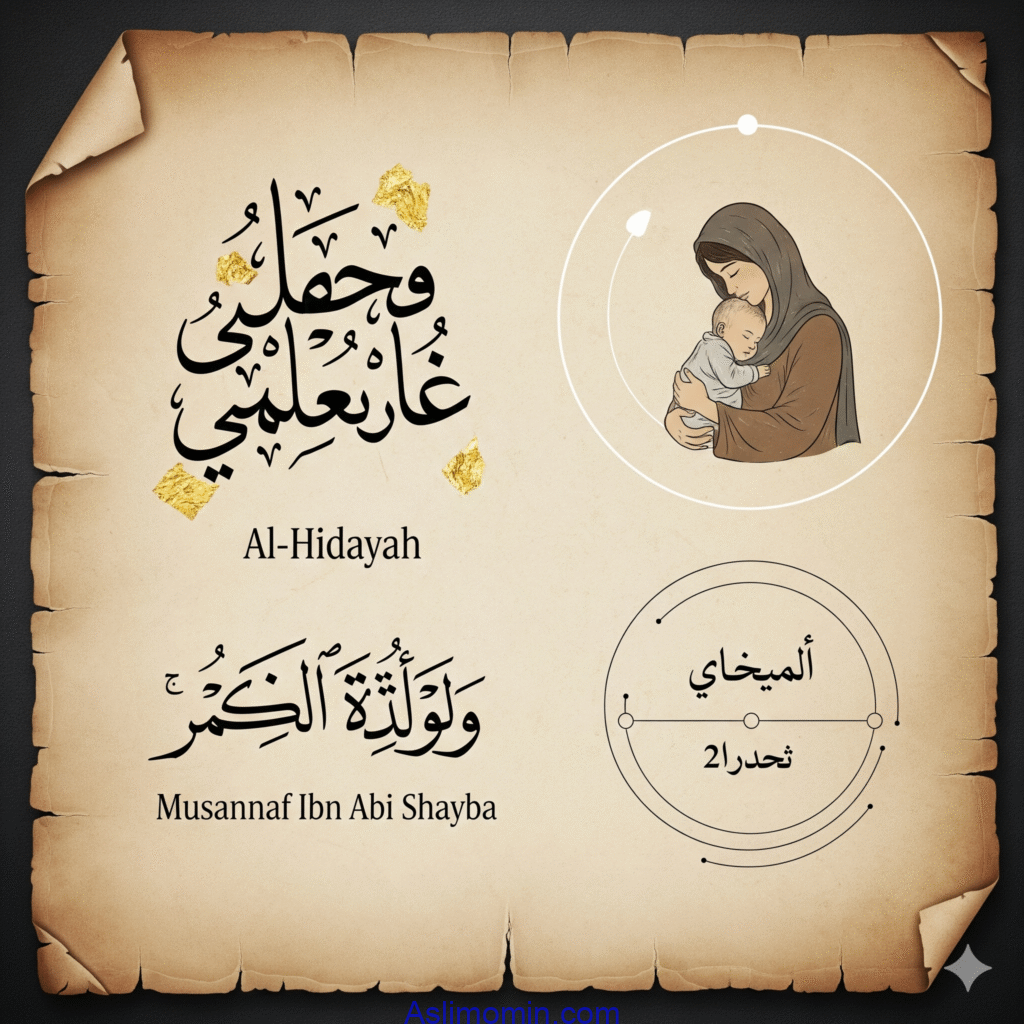
— Al-Hidayah, Vol 2, Kitab al-Nikah
— Hidayah, Charles Hamilton translation
— Musannaf Ibn Abi Shaybah (Hadith 23456): A woman gave birth two years after her husband’s absence during Umar’s time and the child was deemed legitimate.
This suggests that such rulings were possibly tailored to accommodate unique cases, such as the Prophet’s own birth.
Tafsir and Narratives: Ideological Backing for Long Pregnancy
To reinforce this belief religiously, several narratives and stories were offered:
- Imam Malik – Al-Muwatta, Kitab al-Talaq
“A woman may carry a child in her womb for several years.” - Haml al-Fil (Elephant’s Gestation)
A story attributed to Imam Malik of a woman who gave birth after 4 years, and the child was born with developed hair and teeth.

- Incident from Umar’s Time
A man returned after 2 years to find his wife pregnant. After investigation, the child was born with teeth and was named Sahak.
— Al-Isti’ab – Ibn Abd al-Barr - Abbad ibn Awam’s account
A slave woman gave birth after 4 years, and the baby had shoulder-length hair.
These stories, though highly improbable and unscientific, seem to exist solely to support the idea of the Prophet’s delayed birth with religious legitimacy.
Later Scholars’ Efforts: Covering the Contradiction
Later scholars such as Zurqani – Sharh al-Mawahib (c. 1600 CE) tried to soften the contradiction by claiming that the age difference between Hamza and the Prophet was “approximately equal.”

However:
- Early sources like Ibn Ishaq, Ibn Hisham, and Ibn Sa’d are more reliable due to their proximity to the Prophet’s time.
- Later explanations, emerging nearly 1000 years later, appear to be retrospective justifications aimed at resolving the timeline inconsistency.
Science vs. Fiqh: The Verdict
According to modern medical science, human gestation cannot exceed 9–10 months.
Pregnancy durations of 2–4 years are biologically impossible.
Hence, the acceptance of such prolonged periods in fiqh appears not to stem from scientific observations but rather from a need to preserve religious and historical consistency.

Conclusion: A Historical Fact and Its Veil
The earliest Islamic sources—Ibn Ishaq, Ibn Hisham, Ibn Sa’d—clearly suggest that Prophet Muhammad (ﷺ) was born 2 to 4 years after Abdullah’s death.
Hamza’s older age and the simultaneous marriage of Abdul Muttalib and Abdullah support this estimation.
Since this contradicts natural gestation, Islamic jurisprudence extended the permissible pregnancy period to 2–4 years.
To legitimize this, fiqhi laws, tafsir-based stories, and later scholarly reconstructions were introduced—but none of these have a basis in science.This analysis is not intended to offend religious sentiments but to critically examine a historical reality in the light of authentic sources.
📢 Did you find this article useful?
🙏 Support our work by clicking here.