

“An Almighty being perched atop civilization, speaking hatred, curses, and vulgar anatomical references — can He truly be the Compassionate?”
Is This Divine Language or Human Anger?
(A Study of the Language of the Quran and Hadith)
Note: If you feel this content might offend your sentiments, please first read the [Disclaimer].
In previous articles, we examined the concept of God that resides within us and His attributes, comparing them with the image of Allah depicted in Islamic scriptures. This time, the question arises—is the language used in the Quran and Hadith truly divine?
Can the speech of a God who embodies compassion and justice contain words of insult, abuse, or disdain?
1. When God Himself Uses Offensive Language
Harsh Address for Non-Muslims
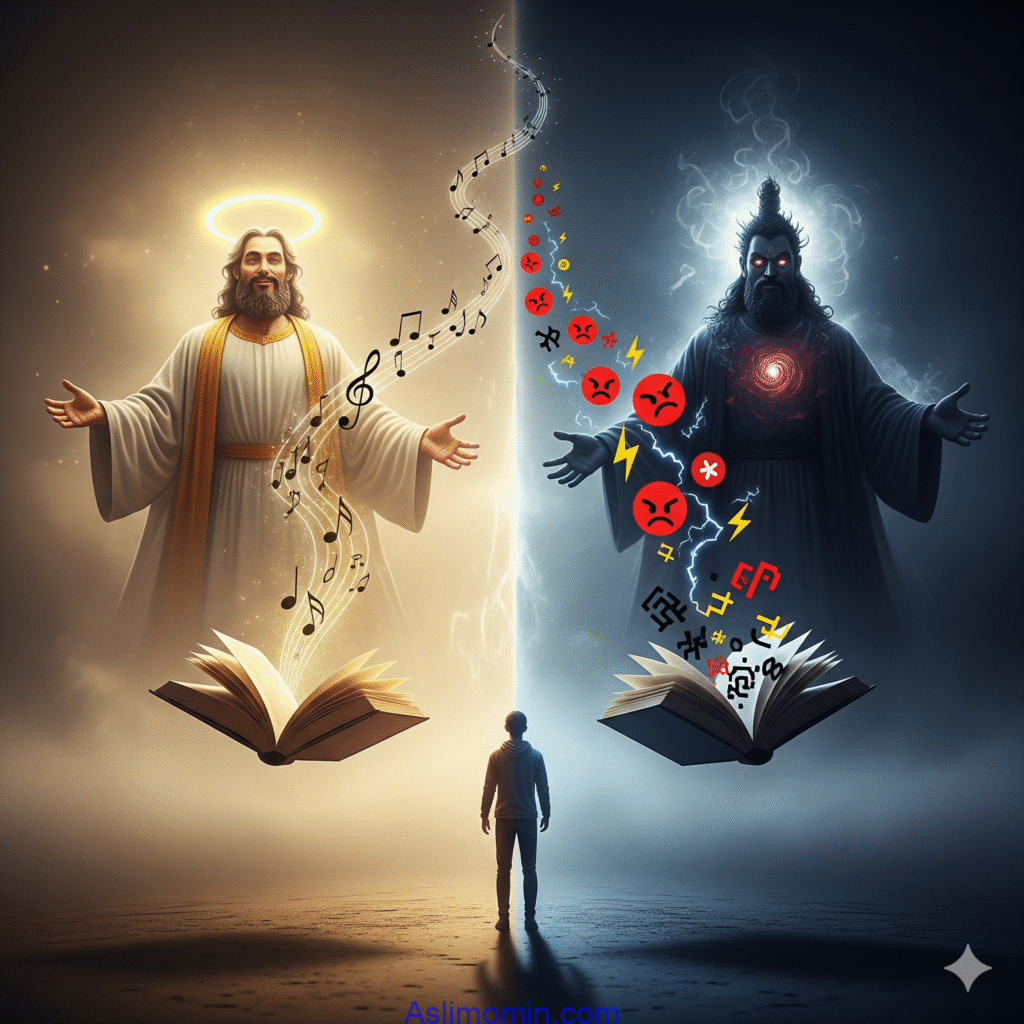
The Quran contains numerous instances of harsh and insulting terms for those who do not accept Islam:
Quran 9:28
“Al-Mushrikoon (polytheists) are Najis (نَجَسٌ).”
➤ “Najasun” translates to “impure,” “filth,” or even “excrement.”
This raises the question—can a God who addresses His creation in this manner truly be considered omniscient, compassionate, and universally fair?
Quran 68:10-13 (Surah Al-Qalam)
“Do not obey any liar, any one who invokes curse, any mocker, nor those who forbid good, nor those who are vile and indecent—Zaneem (زنیم).”
Exegeses interpret “Zaneem” as:
- Ibn Kathir: “illegitimate son” (harami)
- Tafsir al-Jalalayn: “one whose lineage is uncertain”
2. Comparison with Animals: Monkeys, Donkeys, Dogs, and Pigs
The Quran compares certain non-Muslims to animals:
| Animal | Reference (Quran) | Explanation |
|---|---|---|
| Monkey | 2:65, 7:166 | Jews were turned into monkeys |
| Pig | 5:60 | Jews and Christians are called pigs |
| Donkey | 62:5 | Jews to whom the Book was given are likened to donkeys |
| Dog | 7:176 | Example of non-believers is like a dog |
| Worst of all animals | 8:55 | Those who deny are the worst on earth |
Additionally, Quran 47:4 instructs:
“When you meet the disbelievers, strike their necks until you crush them. Then bind your captives and release them either by grace or ransom.”
This language points toward revenge, anger, and violence.
The question arises—is this divine speech, or a direct promotion of religious and racial hatred (“Divine racism”)?
Would a merciful and omnipresent God communicate with His creation in such a manner?
3. Muhammad’s Obscene Command: “Cut Off the Father’s Genitals”
Al-Adab Al-Mufrad 963 (Sahih Chain) states:
“Command the one who traces his lineage to pre-Islamic ignorance to cut off his father’s genitals. Speak clearly, not in gestures.”
This is neither peaceful nor civilized—it is a distorted, wrathful, and obscene order. A prophet, described as a “model of ethics” (Q 68:4), openly instructs cutting genitalia?
Is this truly divine inspiration, or a reflection of human anger and rage?
Other Hadith also call Jews and Christians “Maghdoob” (those under Allah’s wrath). Can such language ever symbolize compassion or civilization?
Al-Adab Al-Mufrad 963 (Sahih chain)4. Abu Bakr’s Statement—“Lick the Vulva of Al-Lat”
Sahih al-Bukhari 2581 records Abu Bakr saying:
“Go lick al-Lat’s clitoris!”
(Arabic: “امصص بظر اللات” — Imssas Buzur al-Lat)

This is a direct obscene insult targeting female genitalia.
Abu Bakr, exalted as “Ashraful Mubasharah” (one promised Paradise), is delivering an extremely vulgar and offensive statement.
Such language is obscene and purposefully insulting, raising the question—can this align with a divine command?
Sahih al-Bukhari 25815. Allah’s Language: Divine or Human?
Every religion claims that its God provides knowledge and guidance to His people. Yet, some verses of the Quran and sayings of Hadith display anger, insult, and harshness.

The question arises—can this truly be divine speech?
If God is omniscient and omnipotent, would He communicate with His creation in this way, or did the human authors include their own anger, resentment, and contempt into the scripture, later declaring it “divine”?
6. “Abuse” or “Divine Warning”?
Some scholars argue that harsh language in the Quran and Hadith was intended to intimidate and discipline opponents and disbelievers.
But can divinity ever be justified through fear and insult?
If God’s message is genuinely about love, compassion, and justice, can His language be so harsh and occasionally indecent?

The reader is invited to reflect:
- Can God genuinely use offensive language?
- The commands of the Prophet are often considered timeless and universal. If we dismiss some harsh statements as “specific to that time,” then all orders would be subject to the same scrutiny.
- It becomes a double standard when only controversial statements are excused as contextual, while others are upheld as eternal.
Some say these are mere metaphors. But can an omniscient God select so derogatory and insulting words even in metaphor? Could He not have simply said, “They have strayed from the truth” or “They are in ignorance”?

7. Language and the Image of God
Reading the harsh and insulting statements of the Quran and Hadith raises the question:
- Can this truly be divine speech?
- Or does it reflect human reaction—anger, hatred, and contempt?
If it is divine, should we assume that God Himself can employ curse words and harshness?
8. Conclusion
Even a parent controls their language in front of children to shape thoughts, yet the Quran and Hadith display language that is harsh, insulting, and wrathful.
Can this truly be the language of a merciful, compassionate, and just God?
Or is it the product of human anger and social conflict, later declared “divine speech”?

A devout Muslim reading this as divine may conclude that anger, curse, and harshness are part of religious conduct, explaining rigidity and intolerance in religious practice.
But if this language is human, not divine, it implies our understanding of God has been distorted and overlaid with human weakness.
Reflective Thought
- Does this language correspond with the divine image we envision—just, compassionate, and loving?
- If not, should we consider that human intervention has obscured God’s image in religious texts?
- Or will someone accept that, “Yes, my God can speak in offensive words”?
Both perspectives are presented. The judgment rests on your conscience and reason.
Key Message:
- Religion of civilization is not filled with insults and abuse.
- God does not call His creation impure or offensive.
- Prophets do not issue excessively harsh and insulting commands.
- Religion should not be steeped in hatred, racism, and vulgarity.
If divine speech is assumed to be filled with insult, curses, and hatred, it cannot align with the universal, loving, and just God we imagine in our hearts.
📢 Did you find this article useful?
🙏 Support our work by clicking here.