
Introduction
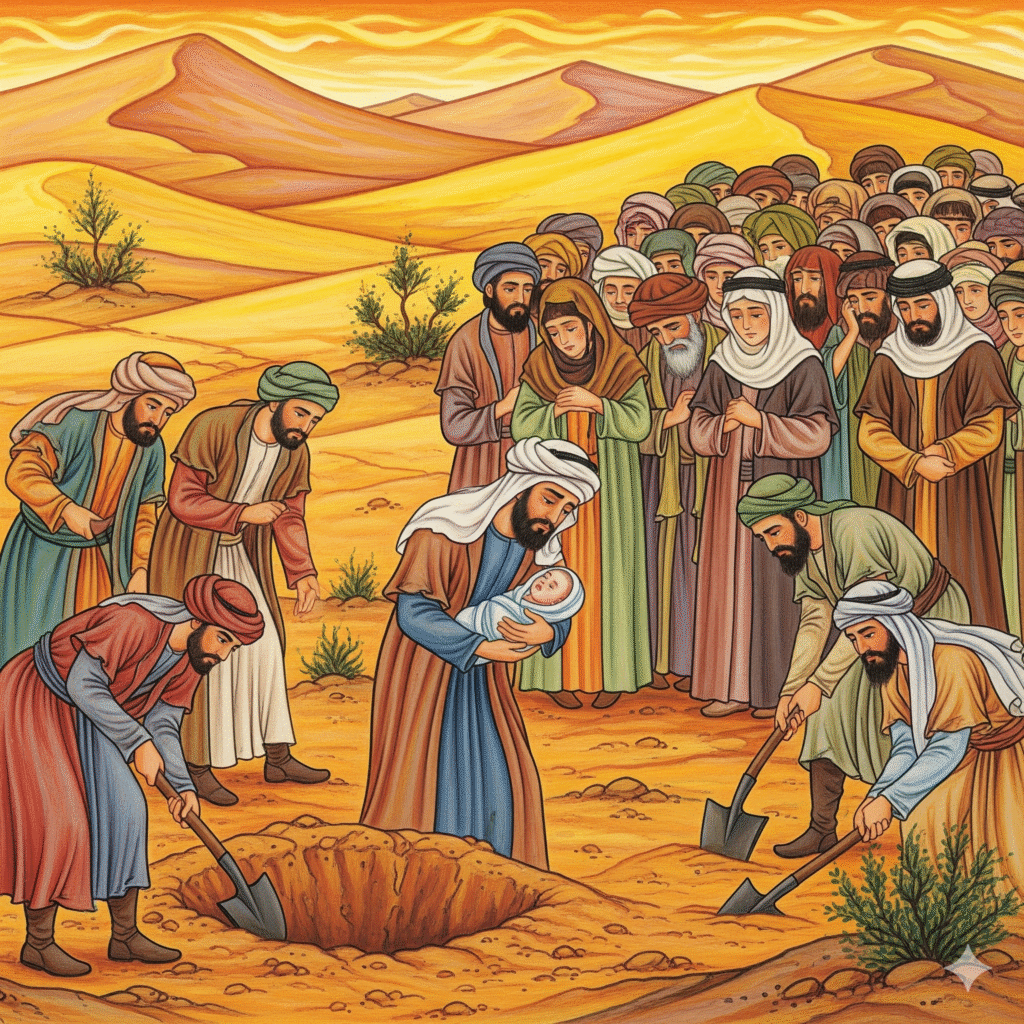
If Islam truly beat the drum of saving Jahiliyyah’s buried daughters and granting them honor, why didn’t a single Khadija-like business tycoon or Maymuna-like queen emerge after Islam—wasn’t it all a sham and pretense? Jahiliyyah was notorious for social injustices and cruelties, including female infanticide. The Quran and Hadith claim to stop it, but critics say it was just a staged drama, masked (“sugarcoated”) by Islam to chain women in veils and rob their freedom. This article rips the mask off this farce.
1. Prevalence of Female Infanticide: Historical Context
- Nomadic Bedouin Tribes: Some barbaric tribes buried daughters, deeming them burdens.
- Urban Tribes: In Mecca and Yathrib, this practice was a bundle of lies. Tribes like Quraysh and Banu Hashim had women ruling the roost. Examples:
- Khadija: Business tycoon, Muhammad’s employer.
- Safiya: Banu Qurayza’s queen.
- Maymuna: Banu Hashim’s queen, who snubbed Muhammad’s “gift yourself” demand.
- Truth: Citing Nabigha Dhubyani and Ibn Hisham to claim it was widespread is sheer nonsense.
2. Quran’s Condemnation of Female Infanticide
- Surah Takwir (81:8-9): “The buried girl will ask what her sin was?”—Loud noise, but did it really change women’s fate?
3. Reasons or Excuses?
- Fear of Poverty: Some tribes saw daughters as costs.
- War Excuse: Whining about enslavement.
- Question: If daughters were really being buried alive, then where did men get four wives and ten slave-concubines from?
- Historical sources confirm that this practice was not universal but confined to a few tribes, such as Banu Tamim, Banu Aws, and Banu Khazraj (tribes of Medina). For example, Ibn Ishaq (Sirat Rasul Allah, p. 239, ed. Guillaume) and al-Tabari (Tarikh al-Rusul wal-Muluk, Vol. 6, p. 24) mention isolated cases of female infanticide among Banu Tamim after intertribal wars. Likewise, Hadith literature (Sahih Muslim 3029) refers to men like Qays ibn Asim of Banu Tamim who admitted burying his infant daughters before Islam. These records show the practice was exceptional, not widespread, yet Islam later exaggerated and dramatized it on a large scale to project a civilizational reform.
4. Islamic Reform or Women’s Enslavement?
- Muhammad’s Words vs. Brutal Reality:
- Sahih Muslim (Hadith 2631): “Raise two daughters, and I’ll be with you in Paradise.”—Pretty talk.
- Reality: Sahih Bukhari (Hadith 7099): “A nation ruled by a woman is doomed.”—So daughters were just decorative props?
- Sahih Muslim (Hadith 2631): “Don’t harm a daughter, and you’ll enter Paradise.”—Sweet promises.
- Reality: Surah Nisa (4:34): “Beat disobedient wives.”—Daughters spared, wives thrashed.
- Reality: Sunan nasai (Hadith 3963): “Aisha said, ‘Muhammad hit my chest, it hurt bad.’”—Is this their version of honor?
- Sahih Muslim (Hadith 2631): “Raise two daughters, and I’ll be with you in Paradise.”—Pretty talk.
- Women’s History:
- Khadija: Business tycoon, before whom Muhammad bowed.
- Safiya: Queen, seized by Muhammad.
- Maymuna: Queen, who rebuked Muhammad.
- Umm Qirfa: Banu Fazara’s queen.
- “Torn apart by camels on Muhammad’s orders.” (Ibn Hisham)
- “Hearing of her daughter’s beauty, Muhammad hounded the Sahaba for two days; Salma said, ‘She’s yours alone.’” (Sahih Muslim, Hadith 4345)
- Amina: Muhammad’s own mother, from another tribe.
- Kuffar-e-Mecca: 6 of 9 tribes had queens. Yet Islam pinned two tribes’ deeds on the entire faith.
5. Truth Exposed
- Limit: Daughters killed, yet wives aplenty? It was a tale of a few tribes.
- Farce: Islam masked (“sugarcoated”) it to enslave women and cage them in veils.
- Umm Qirfa: Her savage murder and daughter’s predation—was this honor or a lustful game?
ConclusionFemale infanticide was confined to a few tribes, but Islam turned it into a farce to chant women’s honor. Khadija proves women were free in Jahiliyyah. If Islam was women’s messiah, why, in its golden age, did no Khadija, Umm Qirfa, or Maymuna rise? Wasn’t this all a theatrical ploy to shackle women in chains and erase their existence?
Wow, awesome blog layout! How long have you been running a blog for? you make running a blog look easy. The total glance of your web site is magnificent, let alone the content!