
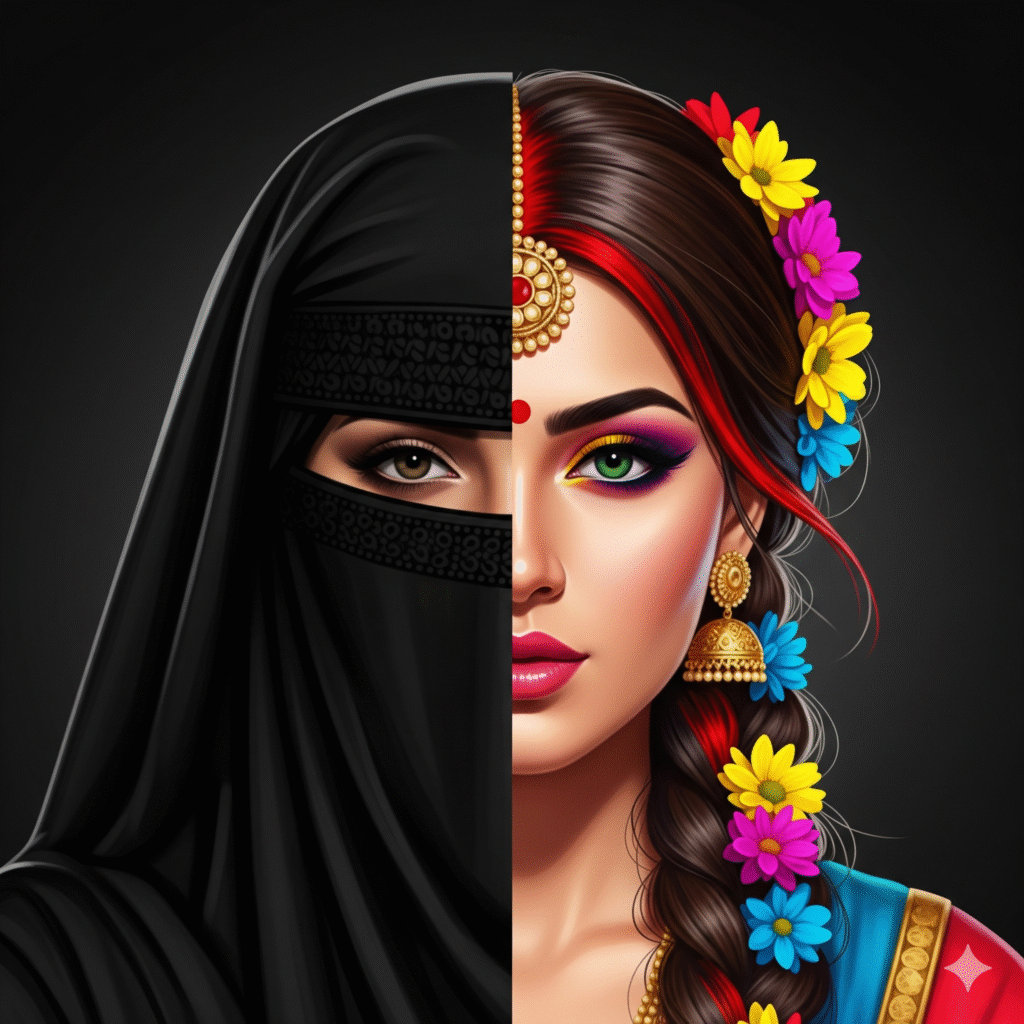
This article is dedicated to those women who wish to marry a Muslim man and often say, “My Abdul is not like that.” as well as to Muslim women who oppose the Uniform Civil Code (UCC), This piece concerns your rights—rights that UCC seeks to protect. Please read this to the end and judge with your own discernment.
“My Abdul Is Not Like That” – A Misconception?
Many women believe that after marrying a Muslim man, they can continue practicing their own faith, or that Islamic rules won’t apply to them. But what does the Quran say?
Surah Al-Baqarah (2:221):
“Do not marry polytheist women until they believe… Surely a believing slave woman is better than a polytheist, even if she pleases you…”
Mushrik means an idol-worshipper. In Islam’s view, marrying a polytheist woman is less desirable than keeping a slave woman (sex slave) to fulfill physical needs. This clearly implies: unless you convert to Islam, your worth is less than that of a slave. If you marry without converting, the Indian Constitution may recognize the marriage, but in your husband’s family and society, it will be considered “zina” (adultery), and your children will be deemed “illegitimate”. This can be verified by any Islamic scholar.
The truth is: No matter how good your Abdul is, he cannot go against the Quran, which is unchangeable until the Day of Judgment. If your Abdul doesn’t believe in the Quran, he will be ostracized from Islam. Sooner or later, you may have to convert to Islam for your children’s legal rights and your marriage’s validity. Are you willing to take this risk? Just as you are ready to leave your parents, family, and society for love, is your Abdul ready to leave Islam for your future’s legal security?
Let us examine this topic from two perspectives:
1. Islamic Perspective: What do Islamic texts say about this topic?
2. Legal and Constitutional Perspective: How do the law and constitution define and regulate this matter?
Islamic Perspective: The Game of Numbers and Power
In Islam, marriage is not merely a personal relationship but a strategic tool.
The Qur’an and Hadith repeatedly emphasize that increasing the Muslim population is the key to their power and dominance.
1. Population Growth: A Religious Command
Qur’an 4:3 – “Marry women of your choice, two, three, or four…”
The purpose here is not just personal life but population expansion.
Sunan Abu Dawud 2050 – The Prophet said:
“Marry women who are very fertile, for I will boast of your great numbers on the Day of Judgment.”
This hadith clearly shows that Muhammad did not evaluate women based on their compassion or human dignity, but rather on their reproductive capacity. Even if a woman was beautiful and from a noble family, if she could not bear children, marriage with her was discouraged.
Thus, the fundamental purpose of marriage in Islam was declared to be producing children and increasing numbers. Muhammad presented it in such a way that: “I will take pride in your large numbers on the Day of Resurrection.”
Reducing a woman to merely a “tool for increasing population” is an insult to women and an attack on their dignity.
This narration is also confirmed in Sunan an-Nasa’i, Hadith 3227, and authenticated by Ibn Hibban and al-Albani in Sahih al-Targhib (Hadith 1921).
Thus, producing children is declared as the core purpose of Islamic marriage.
2. The Divine Gift of Women: Motherhood
Even if there are 100 men, they cannot produce a single child.
But if there are 100 women and just one man, they can produce 100 children every year.
This power lies only with women – the divine gift of motherhood.
In Islamic politics, therefore, women are not just individuals but the production force of the Ummah.
3. “Do Not Give Your Daughter, But Take Theirs”
Qur’an 5:5 – “Lawful for you are the chaste women of the People of the Book (Jews and Christians).”
This means Muslim men can marry Jewish and Christian daughters.
But the reverse is not allowed – a Muslim daughter can never be given to a non-Muslim man.
The meaning is clear: Bring in outside women, never let your own go outside.
This ensures one-sided population growth.
4. The Power Equation
If among 100 men, 99 die but 100 women remain – every year there can still be 100 children.
But if among 100 women, 99 die and only one remains – then only one child can be born.
That is why, in Islamic strategy, women are turned into factories of numbers.
“Love Jihad” is not just an emotional accusation – it is a direct command rooted in Islamic texts:
- The Prophet’s order: Have more children.
- The Qur’an’s rule: Take daughters of Jews and Christians, but never give your own.
- Mathematical truth: The womb of a woman is the real weapon of population and power.
Thus, the divine gift of women (the ability to become mothers) has been turned by Islam into a political weapon.
And if even after knowing all this, you still wish to marry your Abdul, then let us also compare what kind of future awaits you.
Legal and Constitutional Perspective:
Legal and Social Comparison: How Secure Are Your Rights?
Let’s compare women’s rights under the Indian Constitution, Hindu Personal Law, and Muslim Personal Law, covering property, child custody, divorce, religious conversion, adoption, polygamy, and participation in religious gatherings.
1. Property Rights
Indian Constitution:
Articles 14 (equality), 15 (prohibition of gender-based discrimination), and 300A (right to property) grant women equal rights as men.
Hindu Personal Law:
Under the Hindu Succession Act, 1956 (HSA), amended in 2005, daughters get an equal share in ancestral property as sons. Widows also receive an equal share in their husband’s property.
Example: Section 6 (HSA, 2005) grants daughters rights in ancestral property from birth.
Muslim Personal Law:
Under Sharia (Surah An-Nisa, 4:11-12), a daughter gets half the share of a son (2:1), and a widow gets only 1/8th (12.5%, with children) or 1/4th (25%, without children) of her husband’s property.
Verse: “The male’s share is equal to that of two females” (4:11).
Challenge: This gender-based inequality conflicts with constitutional equality (Article 14). Upon adopting Islam, your worth—whether in property or testimony—becomes half that of a man.
2. Child Custody Rights
Indian Constitution:
Under the Guardians and Wards Act, 1890 (GWA), the child’s welfare is paramount. Both parents have equal rights.
Hindu Personal Law:
The Hindu Minority and Guardianship Act, 1956 (HMGA) prioritizes the mother for custody of children under 5. Even after 5, the mother’s financial stability gives her priority.
Example: Section 6 (HMGA) recognizes the mother as a natural guardian.
Muslim Personal Law:
Mothers have “hizanat” (custody) rights, but these are limited: for boys until age 7, for girls until puberty (haiz). After this, custody shifts to the father. Post-divorce, a mother’s rights are further restricted, especially if she remarries.
Hadith: “The mother has the right to custody unless she remarries” (Sahih Bukhari, 5203).
Challenge: A man’s rights remain intact if he remarries, but a mother’s do not. Isn’t this a question mark on a mother’s love? Doesn’t this violate equality rights?
3. Divorce Rights
Indian Constitution:
The Special Marriage Act, 1954 (SMA) and Section 125 (CrPC) ensure gender-neutral divorce and maintenance rights. Women can initiate divorce and claim maintenance.
Hindu Personal Law:
The Hindu Marriage Act, 1955 (HMA) provides equal grounds for divorce (cruelty, desertion) and maintenance for women.
Muslim Personal Law:
Men have the unilateral right to “talaq” (Surah Al-Baqarah, 2:229), while women must seek “khula,” which may require returning the mehr or paying compensation. Maintenance is limited to the “iddat” period (3 months).
Verse: “Divorce may be pronounced twice; then either retain her honorably or let her go honorably” (2:229).
Challenge: The khula process is complex, and lack of maintenance leaves women financially vulnerable. Is this equality, when a woman who spent her life in a burqa or madrasa education struggles to rebuild her and her child’s future post-divorce? In the Shah Bano case (1985), the Supreme Court ruled for maintenance, but political pressure prioritized Muslim Personal Law. Ironically, women were at the forefront of this opposition.
4. Religious Conversion
Indian Constitution:
Article 25 guarantees freedom of religion, including the right to convert. Marriage does not automatically end upon conversion.
Hindu Personal Law:
Conversion may affect property or custody rights but is not gender-specific. Marriage remains valid unless one party seeks separation.
Muslim Personal Law:
If either spouse leaves Islam, the marriage may automatically dissolve. A woman must convert to Islam to marry a non-Muslim man.
Hadith: “Islam is superior to all religions, and no religion can equal it” (Sahih Muslim, 1163).
Challenge: This conflicts with constitutional freedom of religion (Article 25), as conversion conditions affect marriage and child legitimacy.
5. Adoption
Indian Constitution:
The Juvenile Justice Act, 2015 (JJ Act) allows single women, men, or couples to adopt.
Hindu Personal Law:
The Hindu Adoption and Maintenance Act, 1956 (HAMA) grants single women the right to adopt.
Muslim Personal Law:
Sharia prohibits adoption. “Kafala” (fostering) does not grant legal heir status to the child.
Verse: “Allah has not made your adopted sons your real sons” (Surah Al-Ahzab, 33:4).
Challenge: This limits motherhood rights. If you cannot have children due to medical reasons, you cannot adopt. Even if you adopt under the Constitution, your property will go to relatives, not your adopted child, after your death. If childlessness leads your husband (entitled to four marriages) to remarry, your position becomes more insecure.
6. Polygamy
Indian Constitution:
Only one marriage is valid at a time. Polygamy is a crime (IPC Section 494). Divorced women are entitled to maintenance (Section 125, CrPC).
Hindu Personal Law:
The Hindu Marriage Act, 1955 prohibits polygamy.
Muslim Personal Law:
Men are permitted up to four wives at a time (Surah An-Nisa, 4:3). Four marriages at a time means if he divorces one wife, he can marry a fifth wife as well. In this way, he can marry as many times as he wants, there is no limit.
Verse: “Marry women of your choice – two, three, or four; But if you fear that you will not be able to do justice, then marry only one woman, or else instead of marrying your slave girl, satisfy your sexual needs.” (Surah An-Nisa,4:3).
Challenge: The interpretation of “justice” (insaf) in the verse is often exaggerated when presented to women, but there are no restrictions on emotional preferences. In this context, justice refers to equality in financial support, time, living conditions, and treatment. That’s why even a Muslim man living below the poverty line can have four wives — as long as he can provide equally for all of them as he does for one. However, this concept of justice does not impose any restrictions on emotional inclination; a man may prefer or love one wife more than the others.
At times, the definition of justice is expanded to include a woman’s inability to bear children. As the author of this article, I believe that “a woman is not born merely to become a mother – she is a complete life in herself.” But upon adopting Islam, this perspective often fades away. Conversely, if the man is infertile and cannot become a father, this is rarely discussed. If a woman cannot bear children, the husband is allowed to remarry — but the woman’s freedom remains limited. This highlights how, within Islam or Muslim personal law, a woman’s rights may become insecure, whereas the Constitution ensures her protection in such cases.
7. Mosque Entry and Religious Gatherings
Indian Constitution:
Articles 25 and 26 guarantee freedom of religion and participation in religious gatherings.
Example: In the Sabarimala case (2018), women’s temple entry was upheld as a constitutional right.
Hindu Personal Law:
Women have equal rights in temples and religious gatherings.
Muslim Personal Law:
Many mosques restrict women’s entry, based on social practices.
Hadith: “The best rows for women in the mosque are the back rows” (Sahih Muslim, 440).
This restriction is often justified as “protection” or avoiding “evil eyes.” But the question is: if all in the mosque are believers, who poses a threat, and whose gaze is evil?
Challenge: This conflicts with constitutional religious freedom.
8. Political Participation
Quran and Hadith:
Women’s political participation is explicitly restricted.
Hadith: “A nation will never succeed if it entrusts its affairs to a woman” (Sahih Bukhari, 4425).
Example: In Pakistan, Benazir Bhutto’s premiership (1988) was opposed by Islamic groups (Jamaat-e-Islami, Deobandi, Salafi ulema) citing this hadith.
Muslim women’s political participation in India is possible due to the Constitution, not Sharia. If Sharia replaced the Constitution, women would be confined behind veils, as happened to pre-Islamic figures like Khadija (business tycoon), Safiya (Banu Qurayza queen), Maymuna (Banu Hashim queen), and Umm Kirfa, who were reduced to obscurity post-Islam.
9. Other Anti-Women Beliefs
- Only 1/8th (12.5%) of the husband’s property after his death.
- A daughter’s marriage is permissible post-puberty (haiz), without age or maturity conditions.
- Husband’s right to physical discipline (Surah An-Nisa, 4:34).
- Mandatory fulfillment of sexual desires, even unwillingly (Surah Al-Baqarah, 2:223; Sahih Muslim, 1436D).
- More women in hell (Sahih Bukhari, 304).
Conclusion
The Indian Constitution provides a progressive framework for women’s equality, freedom, and rights. Hindu Personal Law, through reforms (HSA, HMA, HAMA), aligns with constitutional values. In contrast, the lack of reforms in Muslim Personal Law limits women’s rights, conflicting with constitutional equality.
Women who say, “My Abdul is not like that,” must understand: your Abdul is bound by the Quran and Hadith, unchangeable until the Day of Judgment. Muslim women opposing UCC are standing against their own freedom and rights.
Love Jihad evokes anger and curiosity. The Indian Constitution grants you the freedom to choose your partner, but this choice can either empower you limitlessly or reduce you to an object of consumption.
Ask yourself: Just as you are ready to leave your parents, family, and society for love, is your Abdul ready to leave Islam for your legal security?
Before opposing UCC, think again: What’s your issue with a law addressing divorce, polygamy, equal property rights, and adoption? Or have your religious leaders misled you, as with CAA, claiming it threatens citizenship?
Think, understand, and decide with your conscience.
Thank you