

An Academic Dissection of the All India Fatwa Board’s Ruling on ‘Suicide-Terrorism’
The purpose of this review is to evaluate the extent to which this fatwa adheres to established Islamic philosophical, linguistic, and fiqhi (jurisprudential) standards.
It is often claimed that the application of aql (reason/intellect) is discouraged in Islam, a claim that is substantiated both by this fatwa and by those who endorse it.
Source Credibility and Institutional Ambiguity
A body not found anywhere in the traditional Indian Islamic institutional landscape, the “All India Fatwa Board (AIFB),” recently issued a fatwa declaring khudkushi (suicide) and dahshatgardi (terrorism) as Haram (forbidden).
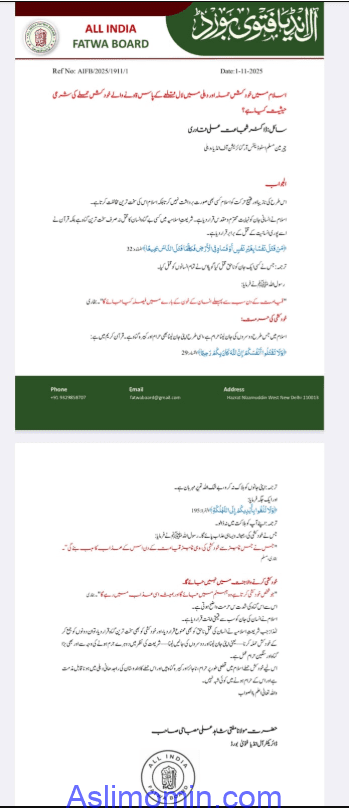
This fatwa is akin to a medical student attempting surgery after only viewing the illustrations in an anatomy book: the zeal is evident, but the proportion of knowledge is critically limited. Before commencing a linguistic, historical, and contextual analysis of the fatwa‘s claims, an investigation into the reliability of its source is essential.
The academic roots of the All India Fatwa Board are opaque. It does not appear to be affiliated with any established Darul-Uloom, Nadwa, Ashrafia, Nizamia, or Jamia—major recognized Islamic universities (Madrasas). The chief signatory, Mufti Shafqaat Mohammed Noori Sifayi, has an academic or research output that is publicly unrecognized. He is not listed in any recognized Barelvi Darul-Ifta, nor is he acknowledged by Deobandis or Ahle-Hadith scholars. The institution is neither cataloged in the records of the AIMPLB (All India Muslim Personal Law Board) nor in major Deobandi or Barelvi compilations. The Mufti’s research, books, or legal works are, on record, non-existent.
This implies that the fatwa emanates from a “board” that is not recognized by any major Islamic university council; it can, at best, be described as a Private Limited Religious Opinion Company.
1. The Deceptive Use of Quran 5:32: Imposing Jewish Law on Muslims
The fatwa confidently cites Quran 5:32 to argue against terrorism: “Whoever takes one innocent life, it is as if he has killed all of humanity.” While this sounds appealing, like a brochure slogan, the critical problem is that this verse is not addressed to Muslims.
The fatwa deliberately conceals the preamble of 5:32. The original Arabic text explicitly states:
$$مِنْ أَجْلِ ذَٰلِكَ كَتَبْنَا عَلَىٰ بَنِي إِسْرَائِيلَ\dots$$
“Because of that, We decreed upon the Children of Israel (Bani Israel/Jews)…”

The context of this verse begins with the story of Cain and Abel and specifically addresses the Law of the Jews (Talmudic principle). Classical exegetes (Tafsir) like Ibn Kathir, Qurtubi, and Tabari all identify 5:32 as the Shari’ah (law) of the Children of Israel. No classical interpretation ever deemed it the law for Muslims. Applying this text to Muslims is selective and misleading. This verse simply does not apply to Muslims.
The Mufti presented this verse as if creating a “Humanity Day” poster, but the real maneuver was omitting the very next verse, 5:33, which does apply to Muslims.
Immediately following 5:32, the Quran states the law for Muslims:
“Indeed, the penalty for those who wage war against Allah and His Messenger… is that they be killed or crucified or that their hands and feet be cut off from opposite sides, or that they be exiled from the land…”
That is, amputation, crucifixion, and exile. The Mufti concealed all mention of these punishments, much like a child erasing “difficult questions” from their homework.
2. Quran 4:29: The Fabricated Imputation of the Word “Suicide”
The fatwa cites Quran 4:29:
“Wa la taqtulu anfusakum” – Do not kill yourselves (literally, ‘Do not kill your souls/selves’).
However, the Arabic original of 4:29 is:
$$لَا تَقْتُلُوا أَنْفُسَكُمْ$$
The literal and contextual translation is: “Do not kill one another” or “Do not commit communal violence.” If ‘la taqtulu anfusakum’ meant ‘suicide,’ why did thousands of Companions (Sahaba) during the time of Muhammad understand it as ‘Do not kill each other’?

The Arabic word for ‘Suicide’ is انتحار (Intihar), and it does not appear even once in the entire Quran. This concept is a later development in Islamic fiqh interpretation.
The level of Quranic translation in this fatwa is this: the text says, “Do not kill one another,” and the translation rendered is, “Suicide is forbidden.” This is akin to translating “No Smoking” as: “Go home and drink tea.”
3. Quran 2:195: Misinterpreting Spending in Jihad as Suicidal Attack
The Quran states: “Spend in the way of Allah, and do not throw yourselves into halakah (destruction).”
Here, not spending is referred to as halakah (destruction). Yet, our religious scholar, the Mufti, interprets this to mean: “Suicide is forbidden.”
However, the context of halakah refers to stopping financial contribution or retreating from the battlefield during war. The Mufti has attempted to establish a modern doctrine of ‘Suicide is forbidden’ by altering the fundamental Arabic meaning.
4. Ignoring Jihad fi Sabilillah and the Glorification of Martyrdom
If death and terrorism are the core subjects, why did the Quranic chapters that glorify death in Jihad fall victim to the Mufti’s “scissors”?
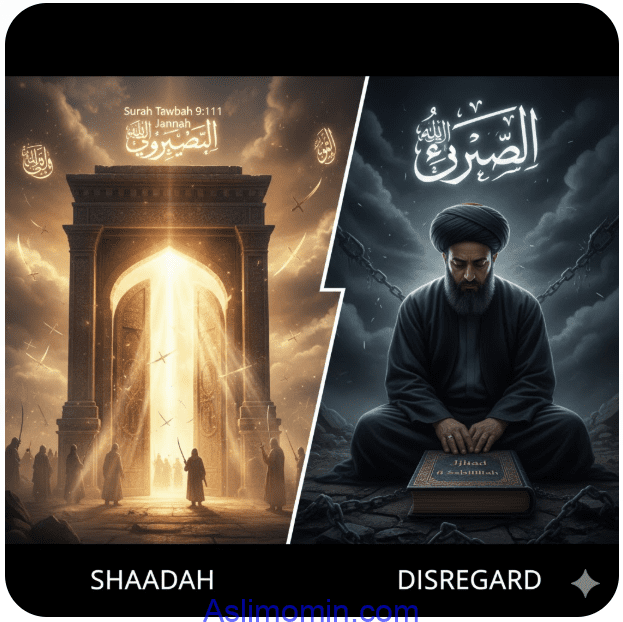
- Surah Tawbah 9:111 (The bargain of “selling” oneself for death):$$ وَيَقْتُلُونَ وَيُقْتَلُونَ$$— “They kill and are killed… Allah has purchased Paradise in exchange for them.” Here, being killed (combat death) is described as a bargain with Allah. This means combat-death is not only acceptable but is explicitly rewarded. The fatwa hides this, as it is a direct promise of “Kill-or-be-killed = Paradise.”
- 2:154 (Do not call them dead): “Do not call those who are killed in the way of Allah dead…” This verse clearly establishes that dying in battle is an elevated status, not like ordinary death.
- 3:169–171 (They are alive): “Those who were killed, they are alive, eating in Paradise.” All these verses promote the “desire for martyrdom”; dying in Jihad is desirable and glorified. Yet, the fatwa remains silent on them.
- 2:190–193 (The duty): “…Fight them until there is no more discord (fitnah) and the religion is only for Allah…” This verse declares death during a general conflict to be acceptable and a “duty.”
- 4:74 (The lure of Paradise): “Whoever trades the Hereafter for the life of this world, Allah will give him Paradise… and for the one who is killed in the way of Allah, there is a great reward.”
If “taking one’s own life” is forbidden, why is there a promise of Paradise for giving one’s life?
In essence, the fatwa says: “Do not die.” The Quran says: “There is great benefit in dying.”
Is the Quran right, or is the Mufti right?
The Weakness of the Terrorism Section: Ignoring 8:60
The fatwa states: “Terrorism in the name of Waliullah (Friend of Allah) is invalid.” But the Quran offers no political/aggressive definition of Waliullah; it is a term belonging to Sufi sects, which Deobandis, Salafis, and Ahle-Hadith do not accept.

As for terrorism or ‘causing unnecessary fear,’ the Quran in 8:60 instructs Muslims:
“Gather strength to strike terror (irhab) into the enemies.”
Arabic:
$$تُرْهِبُونَ بِهِ عَدُوَّ اللَّهِ$$
“To strike terror.” Turhibuna (to strike terror) is documented in classical Arabic dictionaries (Lane, Lisan-ul-Arab). The fatwa makes no mention of this.
When the Quran itself is saying: “Create terror,” the fatwa claims: “Creating terror is forbidden.”
This is a conclusion akin to a mathematics statement: “2 + 2 = Planet Mars.”
5. The Theological Loophole of Suicide and Martyrdom in Hadith
The fatwa cites Hadith that state, “The one who commits suicide will go to Hell.” Agreed, but the Hadith that promise “Paradise for giving one’s life” include the following:
- Sahih Bukhari 2818: “Paradise is under the shadows of swords.”
- Sahih Muslim 1909: “One who sincerely desires martyrdom is given the status of a martyr.” This Hadith presents the desire for death as a religious virtue, and it is this very mentality that provides the theological back-door for suicide bombing.
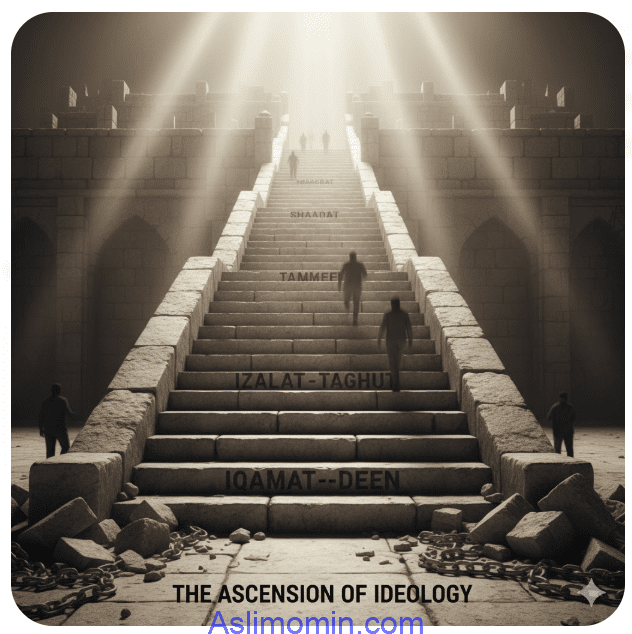
The implication is that if a person dies at home by consuming poison, they go to Hell. However, if a person dies by giving their life in Jihad, they go to Paradise, all their sins are forgiven, and they achieve the highest status.
This theological loophole later became the foundation of suicide bombing ideology: “If you kill yourself, Hell… but if you detonate yourself while attacking in the name of Allah, it is not ‘suicide,’ but ‘martyrdom’.” This is the precise argument used by every Jihadi group.
In Islam: Taking one’s own life = Forbidden, whereas Giving one’s life in Jihad = The greatest reward.
Essentially, “Death is bad, unless we approve the format.”
Islamic history is replete with examples where Muslims regarded the act of “giving their lives” as the highest form of worship. Muhammad himself said: “I wish I could be killed in the way of Allah, then brought back to life, and then killed again—repeatedly.” (Sahih Bukhari 2796-97)
Kharijis, Ghazis, and slave armies were all sent with the intention of “giving their lives.” If giving one’s life were forbidden, the entirety of Islamic history would be tainted by the forbidden.
6. Conclusion: The Fatwa is a Cosmetic PR Document
The document issued by the “All India Fatwa Board” is essentially an Islamic PR brochure.
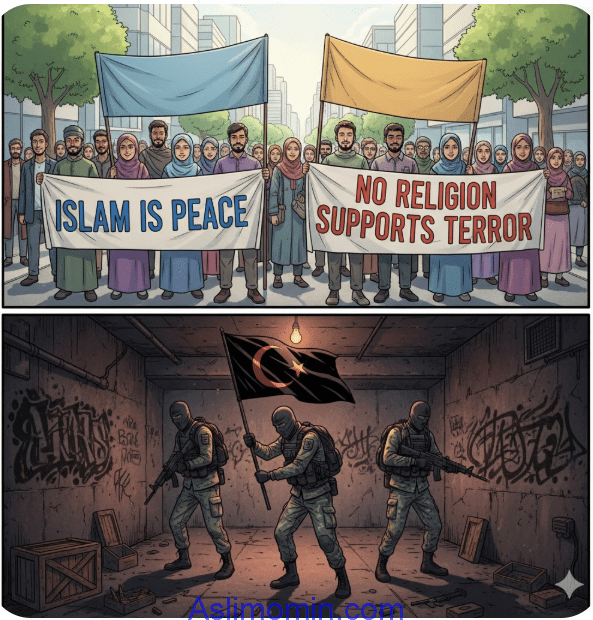
It lacks the depth of fiqh, the honesty of context, the knowledge of Quranic linguistics, and the validity of traditional Islamic institutions. Most importantly, it fails to mention the verses that ISIS, Al-Qaeda, Taliban, and Hizbul Mujahideen use for recruitment, because mentioning them would cause the fatwa to collapse instantly.
On one hand, the Quran is striking a bargain of “selling one’s life for Paradise,” while the fatwa is saying, “Do not set a price on your life.” When Hadith states, “Desiring death is a virtuous act (Sawab),” the fatwa says, “Even the thought of death is forbidden.” The objective of this fatwa does not appear to be the clarification of religious principles, but rather the creation of a ‘protective image-enhancement’ in contemporary political circumstances.
If martyrdom has opened the door to Paradise, in whose favor has the fatwa come to close that door—in the favor of Allah, or the government?
“This is why, in our next article, we reveal the real birthplace of terrorism: classical fiqh itself, where violence is framed not as brutality but as a mandatory religious duty, precisely the truth that these fatwas try hardest to hide.”
📢 Did you find this article useful?
🙏 Support our work by clicking here.