

The Imperative of Jihad in the Mirror of Fiqh
“Debates on terrorism, globally and in India, often dismiss the core issue by claiming that ‘terrorism has no religion,’ limiting the entire discussion to mere ‘extremist organizations’ or ‘individual interpretations.’”
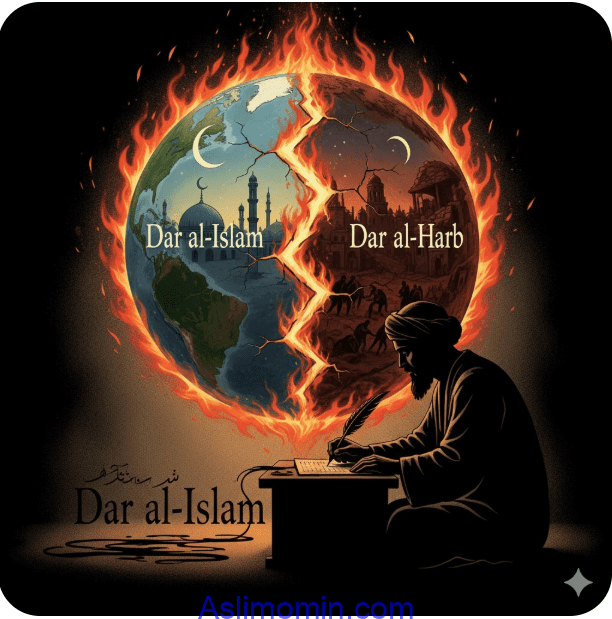
This narrow approach prevents a fundamental understanding of the ideological and religio-political roots of terrorism. The mindset that presents violence as a religious duty is rooted in the classical Islamic legal principle of Fiqh (Islamic Jurisprudence), which divides the world into ‘Dar al-Islam’ and ‘Dar al-Harb’. This division is not merely religious but a well-established political doctrine that justifies violent conflict by framing it as ‘Fard al-Ayn’ (an individual religious obligation).
1. The Foundation of Classical Fiqh: The Principle of Dar al-Islam and Dar al-Harb
Classical Islamic Jurisprudence (Fiqh) divides the world into two opposing domains, which forms the ideological core of Jihadi thinking:
1.1 Dar al-Islam (دار الإسلام)
This is considered the Domain of Peace, characterized by:
- The implementation of Islamic Sharia.
- The presence of Muslim political sovereignty.
- Islamic law being the constitutional basis.
- Authentic References: This definition is consistently found in classical Islamic legal texts such as Al-Mawardi’s Al-Ahkam al-Sultaniyyah, Hidayah, and Fath al-Qadeer.
1.2 Dar al-Harb (دار الحرب)
This is considered the Domain of War (or conflict), where:
- Sharia is not implemented.
- Non-Muslim or “Kafir” authority is in power.
- Governance is based on man-made laws.
- Scholarly Consensus: Major jurists like Imam Abu Hanifa, Imam Shafi’i, and Ibn Taymiyyah reiterated this principle.
- Religious Imperative: According to Classical Fiqh, establishing Islamic rule in Dar al-Harb is generally a ‘Fard al-Kifayah’ (communal obligation), which under certain conditions can escalate to ‘Fard al-Ayn’ (an individual obligation).
1.3 Dar al-Kufr and Dar al-Baghi
- Dar al-Kufr (دار الكفر): This is a general term for non-Islamic, constitutional states where Sharia is not in force. Imam Shafi’i and Ibn Taymiyyah explicitly call it the “Law of Kufr” (disbelief).
- Dar al-Baghi (دار البغي): A region where Muslims enact laws deviating from Sharia (rebellion). This term is also utilized in the Jihadi narrative to legitimize violence against non-Sharia-abiding Muslim rulers.
2. Ideological Codes for Democratic Nations: Taghut and Jahiliyyah
In Fiqh and modern Jihadi political literature, specific technical terms are employed to declare democratic and constitutional states as ideological enemies:

2.1 Taghut (طاغوت)
- Meaning and Context: Taghut literally means “Man-made law deviating from the law of Allah.” It signifies allegiance to an entity or system other than Allah.
- Classical Commentary: Classical Islamic commentary, such as Tafsir Ibn Kathir (in interpreting Quran 4:60), explicitly refers to democracy, parliaments, and man-made laws as “Taghut.”
- Modern Usage: Modern Jihadi and political Islamic groups like ISIS, Al-Qaeda, and the Muslim Brotherhood use this term to oppose democratic nation-states, labeling them as ‘Taghuti Regimes’. Removing such a regime is deemed a religious duty.
2.2 Hukm Ghayr Allah (حكم غير الله)
- Meaning and Context: Hukm Ghayr Allah means “Rule by laws made by humans instead of Allah.” It is a legal and doctrinal term referring to the law of any non-Islamic rule (be it Jewish, Christian, or secular).
- Classical Fiqh: Acceptance of such man-made law is considered ‘Kufr Bawaah’ (Open Disbelief) in Usul al-Fiqh (Principles of Islamic Jurisprudence).
- Modern Usage: This ideology is a direct attack on the legitimacy of democracy. Jihadi groups use it to argue that since modern nations (like India) are governed by man-made constitutions, they are in a state of ‘Open Disbelief,’ making the effort to overthrow them a religious imperative.
2.3 Jahiliyyah (الجاهلية)
- Meaning and Context: Jahiliyyah literally means “The Age of Ignorance,” which existed in Arabia before the advent of Islam, denoting an immoral and barbaric social system.
- Modern Theorist: Sayyid Qutb—the most influential theorist of modern Jihadi ideology—in his book Milestones, rejected all modern nation-states and their political/social systems as the “New Jahiliyyah.”
- Conclusion: The ideological conclusion is that removing the “New Jahiliyyah” of modern nations and implementing ‘Hakimiyyatullah’ (the sovereignty of God) is the Jihadi duty of every Muslim. This concept justifies conflict and ideological isolation within modern societies.
Conclusion of Section 2: While living in democratic countries may be considered temporarily permissible (Dar al-Amn), the ultimate religio-political goal remains the implementation of Sharia in those lands.
3. The Religious Mandate to Transform Dar al-Harb into Dar al-Islam
To change the aforementioned “Taghuti” regions, Fiqh outlines several mandatory religious actions, which Jihadi groups utilize to justify violent conflict:
- Jihad al-Qital (جهاد القتال): This means taking up arms to establish Islamic rule. It is directly mandated by Quranic verses like Quran 8:39 (“Fight them until [there is no fitnah and] the religion is all for Allah”) and Quran 9:29 (“Fight those who do not believe in Allah… and do not abide by the religion of truth”).
- Iqamat ad-Deen (إقامة الدين): The goal is the establishment and enforcement of the Religion (Sharia). This is taken directly from the principle in Quran 42:13 and is the central slogan of organizations like the Muslim Brotherhood, Jamaat-e-Islami, and Al-Qaeda.
- Izalat at-Taghut (إزالة الطاغوت): This is a technical Jihadi term meaning removing the Taghuti (non-Islamic) regime. It is the core objective of modern terrorist manifestos, where the removal of democracy and the implementation of violent revolution are justified.
- Tamkin (تمكين): This signifies establishing/strengthening Islamic rule and acquiring power to implement Sharia. It is inspired by Quran 22:41 (“Those who, if We establish them in the land, will establish prayer and give zakah and enjoin what is right and forbid what is wrong.”).

- Shahada (شهادة): This is giving one’s life for the establishment of Allah’s law (Martyrdom). The traditions in Sahih Muslim describe it as the “straight path to Paradise.” Groups like Hezbollah, Hamas, and ISIS validate suicide attacks by terming them ‘Istishhad’ (seeking martyrdom).
4. Kashmir and Global Conflicts: The Consequence of Religious Doctrine
The religious aspect of terrorism helps decode the nature of regional and global conflicts:
4.1 Kashmir: The ‘Restoration of Dar al-Islam’
If the Kashmir conflict were solely based on “Kashmiri identity” or “political grievances,” the mass exodus of Kashmiri Pandits in 1990 would have been impossible.
- The Real Cause: The Pandits were neither rivals for power nor industrialists; yet, they were targeted because they were non-Muslims and their presence was deemed unacceptable under the ‘Dar al-Islam’ principle for the Kashmir Valley (as the region has been Muslim-majority for centuries).
- This conflict is centered less on land, economy, or local dissent, and more on the Dar al-Islam principle, where the Indian Constitution is compared to Sharia and the settlement of non-Muslims is branded as “Kafir Occupation.”
4.2 Global Examples
- Palestine (Hamas): The Hamas Charter clearly states that Palestine is an “Islamic Waqf” (religious endowment) that must remain Dar al-Islam until the Day of Judgment. The conflict is viewed not as “national” but as “defence of religious property.”
- Syria (ISIS): ISIS declared Assad’s government a “Taghuti Regime,” aiming for the restoration of the “Khilafah” (Caliphate) to implement “True Sharia.”
- Nigeria (Boko Haram): The very name, Boko Haram (‘Western democratic education is forbidden’), operates on the principle of declaring democracy as Kufr (disbelief).
5. Ideological Contradictions and Religious Threat
5.1 The Hypocrisy of Accepting ‘Taghut’ Abroad
The greatest ideological hypocrisy is demonstrated by those who reside in Western nations while rejecting the democratic principles of those very nations as ‘Taghut.’
- Comfort in Dar al-Kufr: Elements who reject the democratic and secular Indian Constitution in places like India, Kashmir, or Assam, simultaneously live comfortably and take citizenship in ‘Dar al-Kufr’ nations like the US, Canada, Germany, or the UK. These Western countries have the same systems of man-made laws, parliament, and democracy that they oppose in India.
- The Fiqh Defense: Classical Fiqh attempts to resolve this contradiction by placing these Western nations in the category of “Dar al-Amn” (Domain of Temporary Safety/Refuge), which skirts the issue rather than resolving it. The explicit contradiction remains: settlement of Muslims is permissible everywhere in India, but the settlement of a non-Muslim in Kashmir is termed “intrusion into Dar al-Islam.”

5.2 The Real Reason for Rejecting the Indian Constitution in Kashmir
The rejection of the Indian Constitution in Kashmir is often masked by mere excuses:
- The Constitutional Question: The Dr. Ambedkar Constitution is gladly accepted in all other Indian states with Muslim populations as an excellent framework for social justice. Why does Kashmir specifically object?
- The Fallacy of Economic Excuse: The argument that “our resources will be seized by outsiders” is a baseless excuse. All citizens of the country have the constitutional right to invest and own property anywhere. No industrialist (be it Adani or Ambani) seizes land by force; acquisition is done at market price.
- The Core Ideological Basis: This rejection is not economic or political, but fundamentally religio-political. It is based on the ‘Dar al-Islam’ principle, where the presence or equality of non-Muslim citizens is considered a threat to the desired Islamic religio-political order.
5.3 The Fear of Jahannam: Terrorism’s Ultimate Religious Motivation
At the heart of the mindset promoting terrorism lies the deep emotional-religious pressure of punishment in the Akhirah (Afterlife), which declares inactivity as the greatest sin.

- Fiqh Clarification: Classical Fiqh clarifies that if a Muslim capable of participating in Jihad for the restoration or defense of Dar al-Islam fails to do so (i.e., fails to fulfill the Shar’i Fard), the consequences will be severe.
- The Grave’s Accounting: The individual will have to answer to the angels in the grave regarding their contribution to Allah’s path. If they failed to contribute to Jihad, they will be condemned to Jahannam (Hell).
- Emotional Pressure: This religious threat places ultimate pressure on young Muslims. They are told that if they are killed in this world, they receive the reward of Paradise; but if they remain inactive, they face eternal punishment in Jahannam. This fear of inaction drives youths toward violent action (Shar’i Fard).
Fatwas issued in India largely remain silent on this central religio-emotional pressure, thus failing to address the actual ideological cause of terrorism.
6. Conclusion: The Ideological Root of the Crisis
This crisis is neither purely political nor purely economic; it is a direct consequence of Islamic political doctrine. Fatwas issued in India remain completely silent on this central religio-political doctrine.
In summary, according to Islamic political theory:
- Any area that was once Dar al-Islam cannot remain without Sharia.
- Non-Islamic law is “Taghut.”
- Restoring Dar al-Islam by removing Taghut is a religious obligation (Shar’i Fard).
- The one who fails to fulfill this obligation will be punished in the Afterlife.
Until these principles are openly debated at an academic level, fatwas—no matter how “non-violent” they appear—will never address the root cause of terrorism: the ideological struggle of Dar al-Islam versus Dar al-Harb.
“This is precisely why, in the next article, we demonstrated that violence is not merely an act of oppression, but is recorded in classical fiqh as a religious obligation and it is this very obligation that the fatwas attempt to conceal.”
📢 Did you find this article useful?
🙏 Support our work by clicking here.