
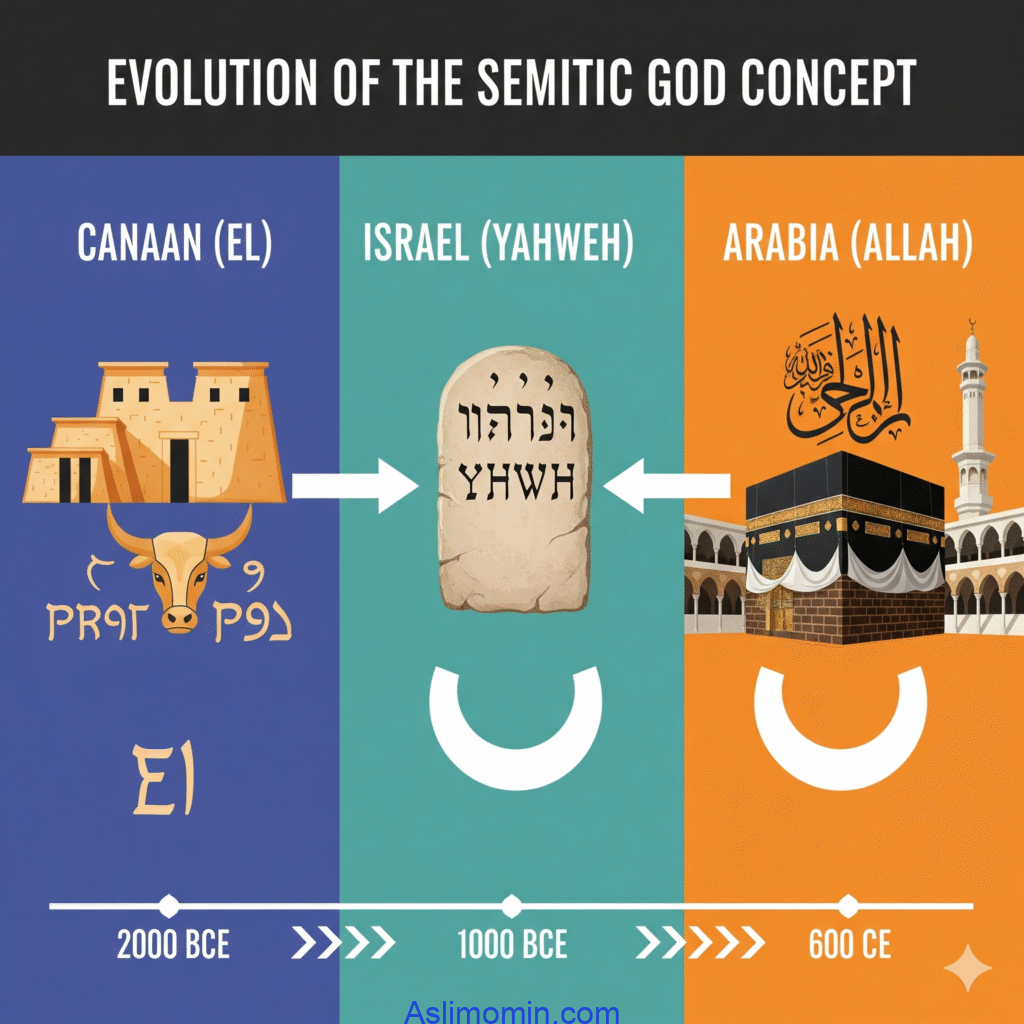
The Historical and Linguistic Journey of El, Yahweh, and Allah
1. The God of the Canaanites: El
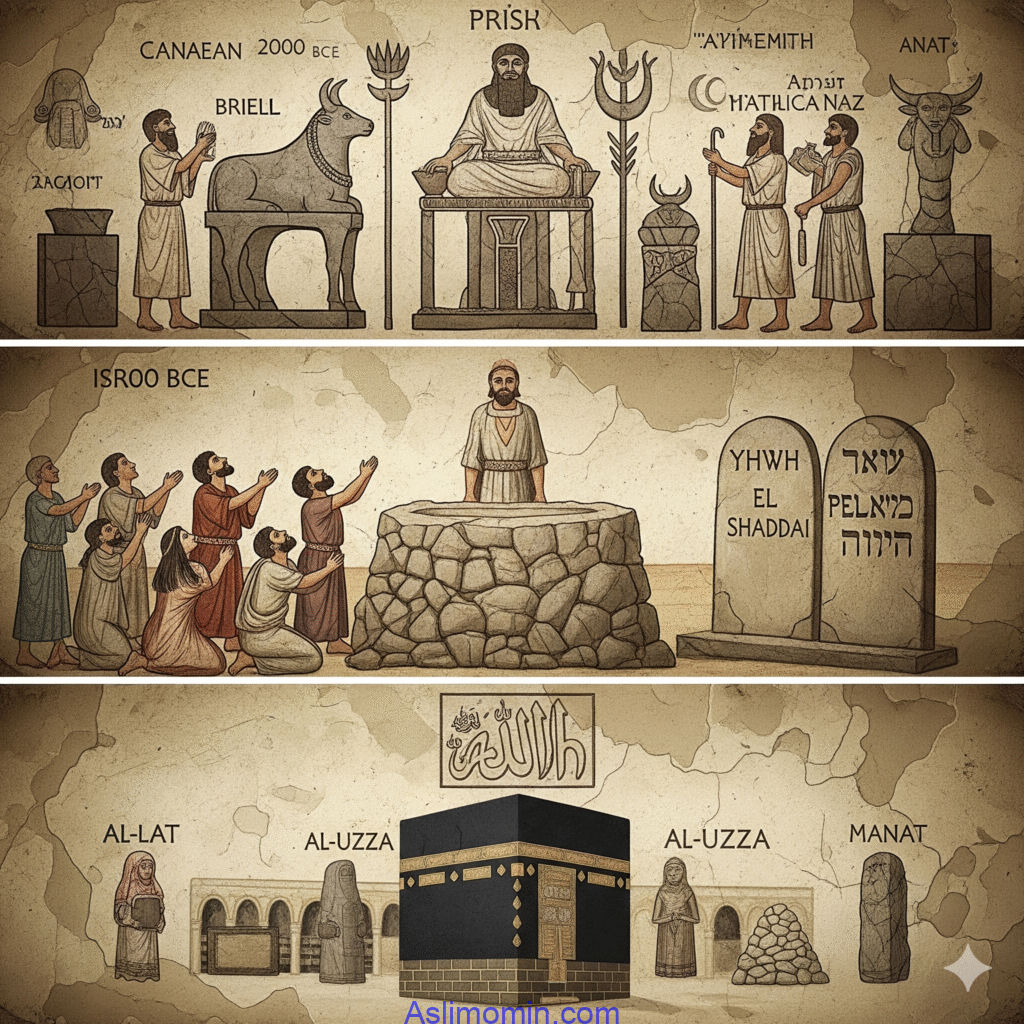
Period: circa 2000 BCE
Region: Canaan (present-day Israel, Palestine, Lebanon, Jordan, and parts of Syria)
The Canaanite civilization was polytheistic, worshipping multiple deities. Among them, the chief god was El, meaning “God.” Other prominent deities included Baal, Asherah, and Anat. The name “El” appears repeatedly in later Hebrew religious texts, for example:
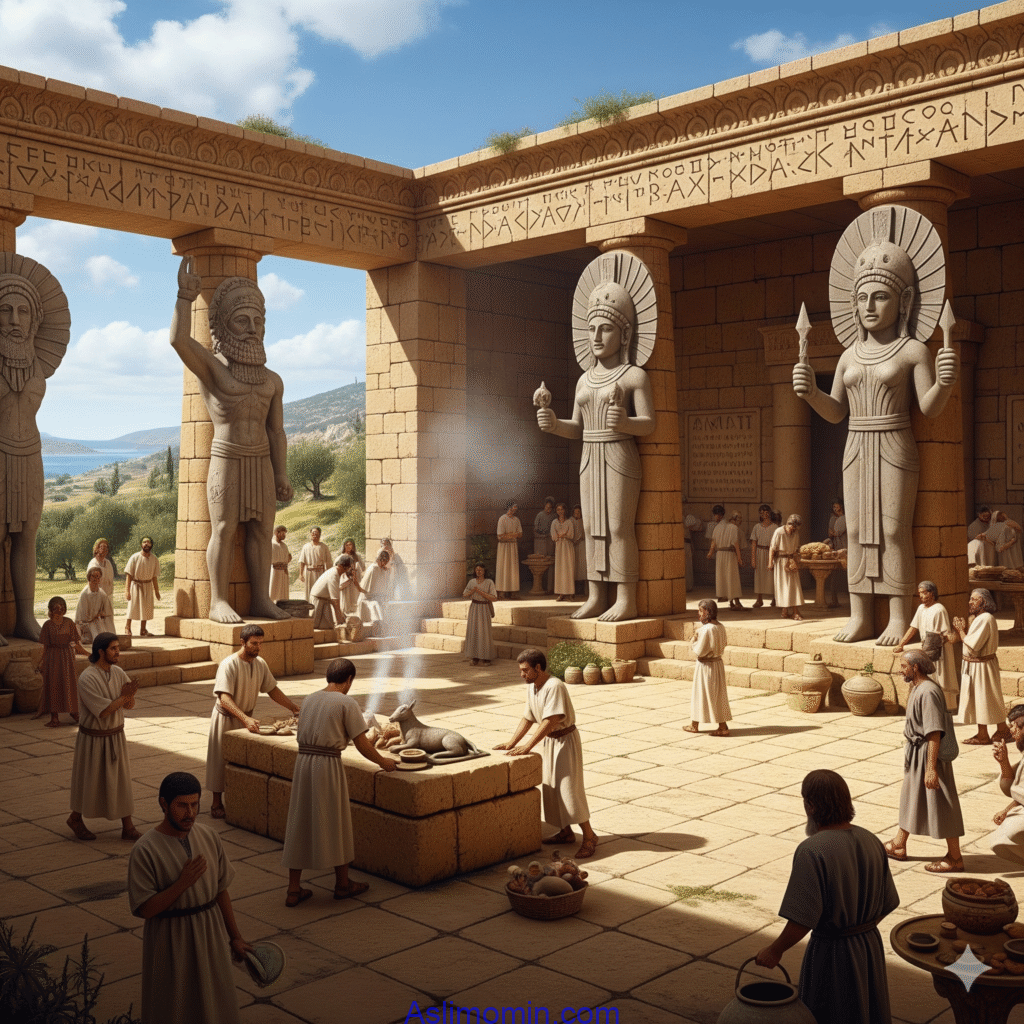
- El Shaddai – Almighty God
- El Elyon – Most High God
Sources:
- Mark S. Smith, The Early History of God: Yahweh and the Other Deities in Ancient Israel
- Karel van der Toorn, Dictionary of Deities and Demons in the Bible
Geographical and Cultural Context:
Canaan was located along the eastern coast of the Mediterranean Sea. Its civilization existed prior to 2000 BCE and was skilled in trade and maritime travel. The Canaanite language belonged to the Semitic family. Canaanites are frequently mentioned in the Bible and other ancient texts, including references to the “land of Canaan” in the era of Israelite prophets.
Religious Context:
Jewish and Christian scriptures portray the Canaanites as idolaters with distinct religious beliefs.
2. From El to Yahweh
Period: circa 1200–1000 BCE
Region: Canaan
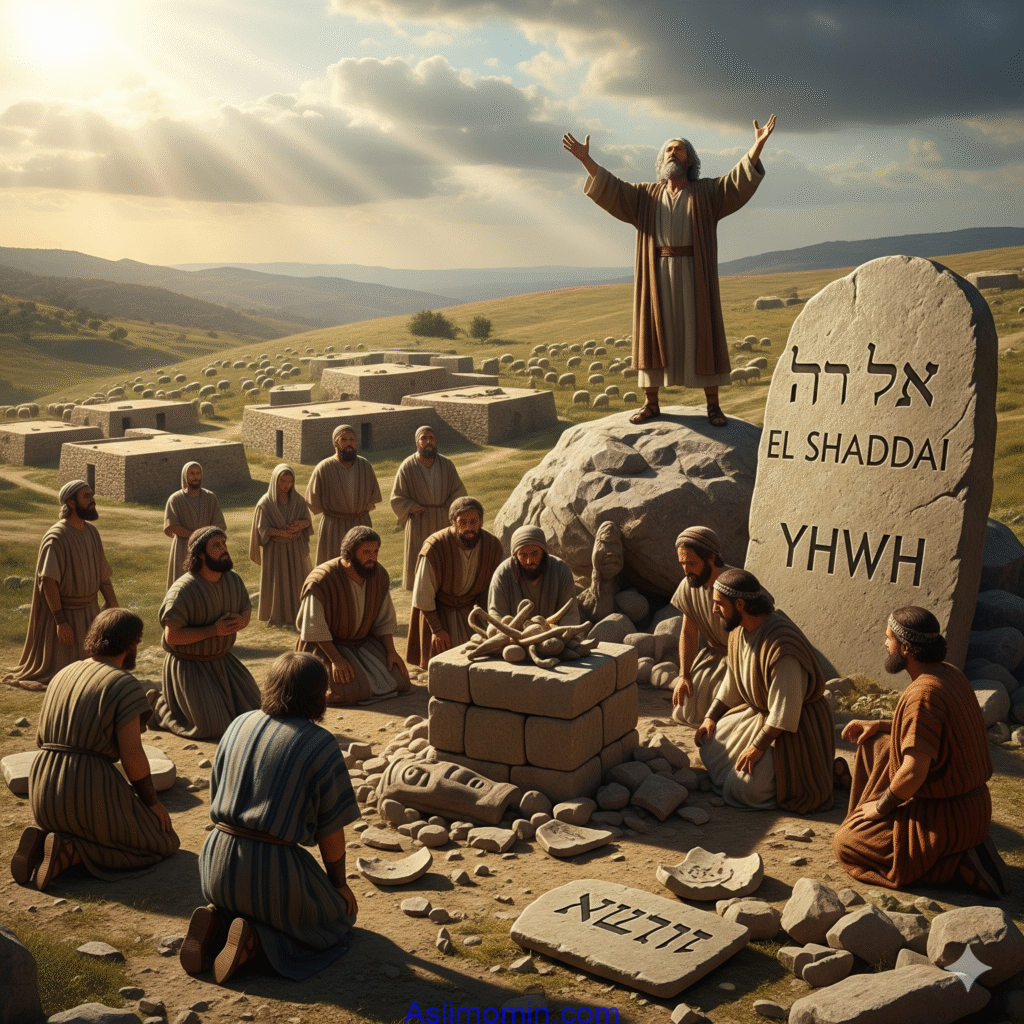
The Israelite (Hebrew) people emerged in Canaan, initially worshipping Canaanite deities. Gradually, they adopted El as their national god, whose form evolved into Yahweh (YHWH). Yahweh was considered the god of Israel exclusively, and other deities were rejected. Early books of the Old Testament show a mixture of El and Yahweh terminology.
Sources:
- The Hebrew Bible (Exodus 6:2–3)
- Thomas Römer, The Invention of God
Relationship between El and Yahweh: Linguistic, Textual, and Historical Contexts
A crucial question arises:
Was “El” actually the same as “Yahweh,” or was it only a generic concept of God?
To understand this, we must look at three levels:
- Linguistic
- Textual
- Historical
✦ Linguistic Perspective
- El (אֵל) in ancient Semitic languages was a generic noun meaning God / deity / divine power.
- It was not an exclusive proper name.
Examples:
- El Elyon (Genesis 14:18) → “Highest God”
- El Shaddai (Exodus 6:3) → “Almighty God”
👉 Here “El” refers to a general divine being, while Elyon or Shaddai are descriptive titles.
✦ Yahweh vs. El in the Hebrew Bible
- Yahweh (יהוה) and El sometimes appear as synonyms, sometimes as distinct.
- Exodus 6:3 states that God appeared to Abraham, Isaac, and Jacob as “El Shaddai,” but later revealed Himself as “Yahweh.”
👉 This means: at the earlier stage, “El” represented a broader divine authority, while “Yahweh” was the specific Israelite deity.
✦ Canaanite and Ugaritic Evidence
- Ugaritic texts (14th century BCE) show that in Canaanite religion, “El” was the supreme father-god.
- Yahweh does not appear in these texts.
👉 Scholars conclude that Israelite religion later absorbed the attributes of El into Yahweh.
✦ El and Yahweh in Names
- Names with El: Israel, Daniel, Gabriel, Michael
- Names with Yahweh: Elijah (Eli + Yah), Hezekiah (Yahu suffix)
👉 This double tradition shows:
- El = Generic God
- Yahweh = Covenant God of Israel
✦ Scholarly Conclusion
- El was not originally the proper name of Yahweh.
- Yahweh was later presented as the true and supreme form of El.
✦ Summary
- El = Generic supreme God / divine power in ancient Semitic tradition.
- Yahweh = Israel’s specific covenant deity.
👉 Over time, Israelite tradition declared Yahweh as “The El” — the authentic and supreme form of El.
3. The Arabian Context and the Word “Allah”
Etymology:
- Ilah = deity / god
- Al = the → Allah = The God (the one and only deity)

Even before Islam, Arabs used the word “Allah” for the sky/creator god, though they also worshipped other deities such as Al-Lat, Al-Uzza, and Manat. The name “Allah” was already known at the Kaaba in Mecca, though it was not considered the sole deity.
The Arabic word “Allah” derives from Ilah, whose roots connect to the Semitic El. Epigraphic and textual evidence shows that both “Ilah” and “Allah” were used to denote a monotheistic deity.
Sources:
- Patricia Crone, Meccan Trade and the Rise of Islam
- Gerald Hawting, The Idea of Idolatry and the Emergence of Islam
4. Allah in Islam
Qur’anic Message:
Prophet Muhammad ﷺ clarified that Allah is the one and only God, without partners.
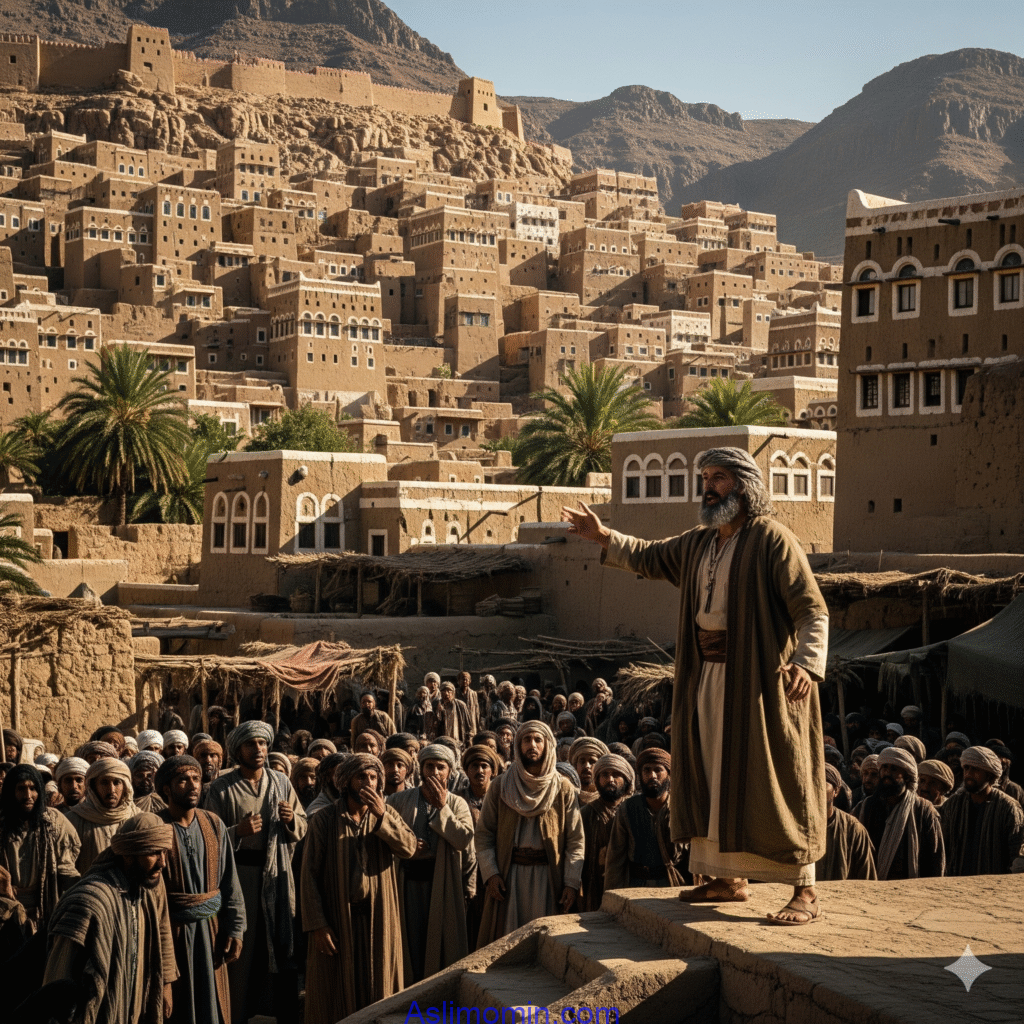
“Say: He is Allah, [who is] One.” (Qur’an 112:1)
Islam established Allah as the supreme, unique, and indivisible deity.
5. Linguistic Comparisons
| Language | Word | Meaning / Notes |
|---|---|---|
| Canaanite / Phoenician | El | God |
| Hebrew | Elohim (plural form), Yahweh | Yahweh as national deity |
| Arabic | Ilah → Allah | The One God |
| Aramaic | Elah / Alaha | Equivalent meaning |
| Syriac | Alaha | Equivalent meaning |
| Greek | Theos | God |
| Latin | Deus | God |
This linguistic development demonstrates that each culture assigned its own name and conceptualization to the same supreme entity.
6. South Arabia, Allah, and Rahman
Pre-Islamic South Arabian Inscriptions (Yemen and Himyarite Kingdom):
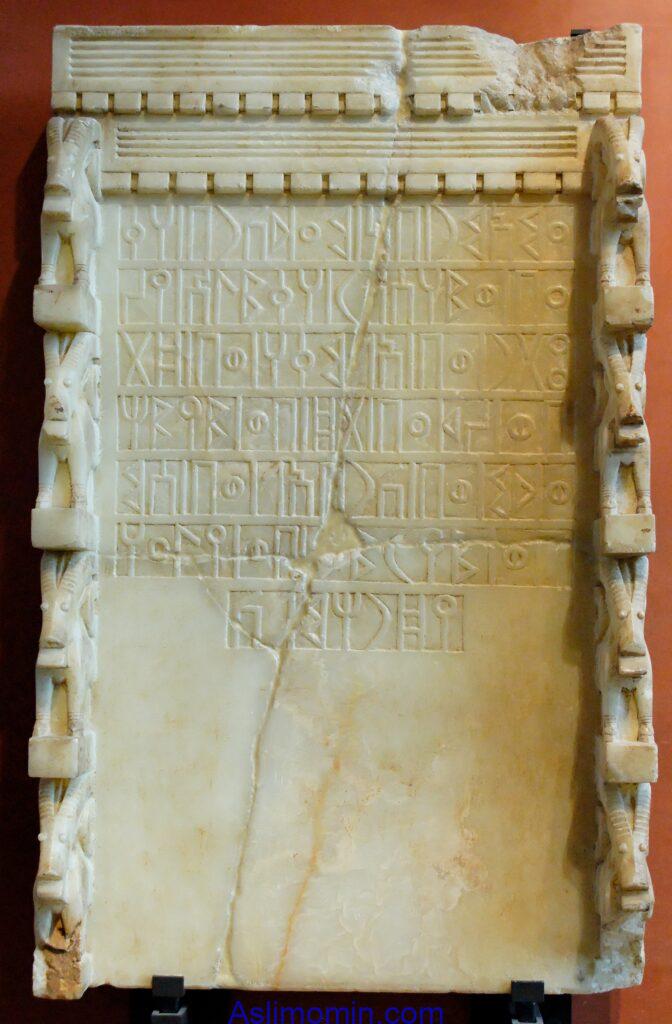
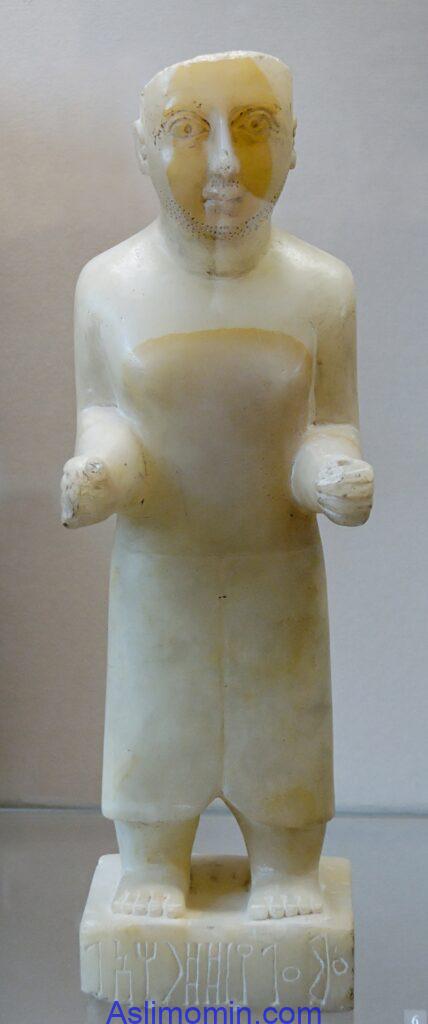
Fourth–fifth century CE inscriptions (CIH 540, Ry 508, Ya 1028) reference major deities. Initially, polytheism prevailed, with gods including: Almaqah, Attar, Talab, Wadd, Sayin, Dhat-Himyam, Al-Uzza, Manat, Allah, and Al-Lat.
Emergence of Monotheism:
Later inscriptions describe a new monotheistic deity as “Lord of Heaven and Earth.” Key terms include ʾlh n (Ilahn) and ʾmrʾ s1 my n w-ʾrḍ n.
Evolution of Allah:
ʾlh → Ilah → Allah. Even before Islam, the term was used for the creator god.
The Emergence of Rahman (Raḥmān):
During the 4th–5th centuries, influenced by Aramaic, Rahman emerged meaning “the Merciful.” Inscriptions such as CIH 540, Ry 508, and Ya 1028 mention Rahman as “Lord of Heaven and Earth” and as “the Lord Rahman of the Jews,” showing its growing monotheistic usage.
Historical Evidence:
- 512 CE Christian inscriptions use the term al-Ilah
- Umm al-Jamal and Jabal Dabub inscriptions mention “Bism Allah” and Rahman
- Scholarly research by Dr. Marijn van Putten and Dr. Ahmad al-Jallad confirms pre-Islamic monotheistic usage of Allah and Rahman
Conclusion:
The word Allah derives from ancient El/Il and Ilah/Ilan, while Rahman arose in the 5th century CE, symbolizing the merciful God. South Arabian inscriptions indicate that both Allah and Rahman were used to denote a monotheistic deity even before Islam.
7. Conclusion
The Canaanite El represents the earliest form of this deity concept. Yahweh is the specific Jewish development of El. The Arab Allah is also part of this Semitic tradition. Islam cemented Allah as the unique, omnipotent, and indivisible God.
This demonstrates that human civilizations shaped the image of God according to historical, linguistic, and cultural contexts, though the roots lie in shared Semitic traditions. The development from El to Allah is a long, complex process combining linguistic, cultural, and religious elements. In ancient Semitic languages, El was worshipped as a primary deity, later evolving into Allah in various religious traditions.
Disclaimer:
These conclusions are based on our independent research and analysis of relevant historical and cultural sources.
They are intended to present knowledge and understanding, not as definitive, immutable truth.
Readers are encouraged to review and assess the findings using their own judgment and additional sources.
📢 Did you find this article useful?
🙏 Support our work by clicking here.
Key References:
- Mark S. Smith, The Early History of God: Yahweh and the Other Deities in Ancient Israel, Eerdmans, 2002
- Karel van der Toorn, Dictionary of Deities and Demons in the Bible, Eerdmans, 1999
- Thomas Römer, The Invention of God, Harvard University Press, 2015
- Patricia Crone, Meccan Trade and the Rise of Islam, Princeton University Press, 1987
- Gerald Hawting, The Idea of Idolatry and the Emergence of Islam, Cambridge University Press, 1999
- CIH 540, Ry 508, Ya 1028 inscriptions, Marib and Ṣanʿāʾ, Yemen
- Wikipedia (Umm al-Jamal, Jabal Dabub Inscriptions)
- Dr. Marijn van Putten, “The Epigraphic Evidence for Pre-Islamic Monotheism in Arabia”
- Dr. Ahmad al-Jallad, Arabic Epigraphy and Pre-Islamic Religious Vocabulary, Medievalists.net